
By Ahmed Ahmed
President Bola Ahmed Tinubu says shared production facilities are being used to address one of the structural barriers confronting Nigeria’s micro, small and medium-sized enterprises, access to affordable equipment and reliable production infrastructure.
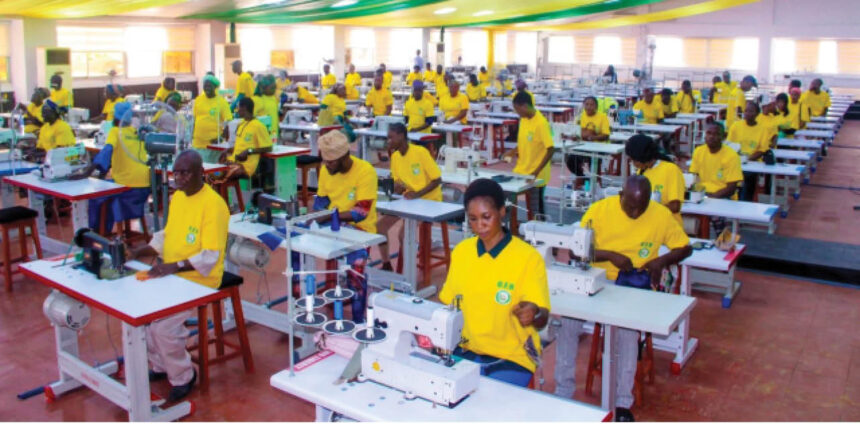
The President said the federal government was investing in shared MSME hubs under the National MSME Clinics, allowing entrepreneurs to use modern machinery, power and production facilities without having to bear the full cost of establishing their own infrastructure.
The President explained the rationale in a post on his official X account, using the examples of a tailor and a food processor to illustrate how the cost of production equipment can constrain businesses that have the skills and market opportunities to grow.
“A tailor should not need millions of naira to buy industrial machinery before she can grow her business. A food processor should not have to build a factory before producing at scale,” President Tinubu said.
“That is why the federal government, under our Renewed Hope administration, is investing in shared MSME hubs through our National MSME Clinics, giving entrepreneurs access to modern equipment, reliable power and production facilities without carrying the full cost alone,” he added.
According to the President, 21 shared facilities are currently operating across 19 states and the Federal Capital Territory (FCT), supporting businesses and an estimated 650,000 jobs.
The approach reflects a practical challenge within Nigeria’s MSME ecosystem. For many small businesses, the barrier to expansion is not necessarily a lack of entrepreneurial capacity, but the cost of acquiring machinery, securing adequate power and establishing suitable production space.
Tinubu said Nigerian entrepreneurs already possess many of the capabilities required to build successful businesses, but that access to productive infrastructure remains a constraint.
“Nigerians do not lack ideas, skill or ambition. Too often, they lack access to the tools and infrastructure needed to turn them into successful businesses,” he said.
“Our job is to remove those barriers,” he stated.
Shared facilities therefore provide an alternative to requiring individual businesses to make large upfront investments in equipment before they can increase production. For businesses operating with limited capital, the model could allow scarce resources to be directed towards raw materials, workers, distribution and market expansion rather than expensive fixed assets.
The President also linked access to production infrastructure with competitiveness. He said businesses able to increase output while controlling production costs would be better positioned to expand and employ more people.
“When small businesses can produce more, at lower cost, they become more competitive. They grow. They employ more people. They create income and opportunity for Nigerian families,” President Tinubu said.
The emphasis on shared facilities also places infrastructure access alongside finance as part of the broader challenge facing MSMEs. Access to credit may not translate into sustained business growth if entrepreneurs still face high costs for equipment, electricity and production space.
For the model to deliver its intended effect, however, the availability of shared facilities will need to be matched by effective management, equipment maintenance, reliable power and transparent access for businesses. The ability of entrepreneurs to use the facilities consistently and translate access into higher productivity will also determine the wider economic impact.
The 21 facilities cited by the President provide an existing base from which the initiative can potentially expand. Their reported support for an estimated 650,000 jobs also places emphasis on the employment potential of MSMEs, although the scale and sustainability of those jobs will depend on the performance and continued viability of the businesses using the facilities.
President Tinubu said the ultimate objective was to enable Nigerian enterprises to become more productive and create broader economic opportunities.
The policy direction places shared productive infrastructure at the centre of efforts to help smaller businesses move from survival towards scale. Its significance will ultimately be measured by whether entrepreneurs can consistently access the facilities, lower their operating constraints, increase production and convert that capacity into sustainable businesses and employment.