
By Jennete Ugo Anya
Nigeria’s human capital development strategy is shifting towards a state-driven model that uses local data to identify priorities, guide public spending and measure progress in education, healthcare, skills and employment.
The National Human Capital Development Programme (NHCDP) said the approach reflects significant differences in human capital outcomes across states, making locally tailored interventions essential to addressing regional disparities.
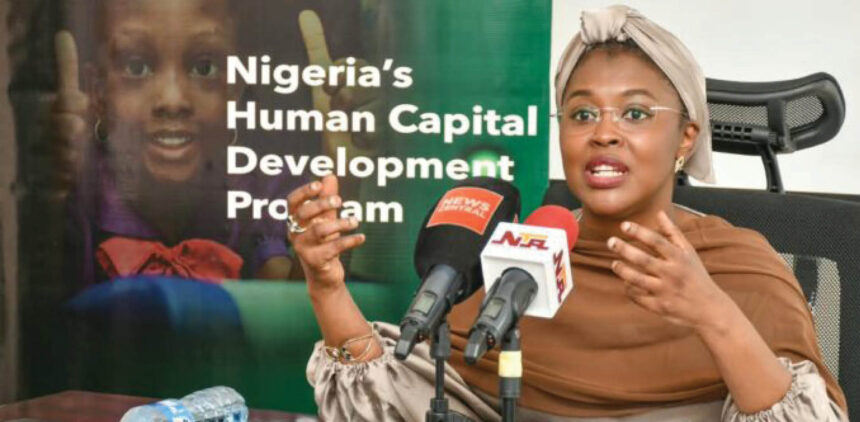
The programme’s National Coordinator, Rukaiya el-Rufai, disclosed this while briefing journalists on its strategy and efforts to strengthen public accountability for human capital outcomes.
El-Rufai said the programme had strengthened its use of data through an in-house analytics team and regional engagements that group states into blocks to examine their respective challenges. Under the framework, each state generates data, identifies priorities and develops a human capital development plan with guidance from the national programme. A designated focal person coordinates implementation in each state.
“Some states are performing well, while others lag,” she said, highlighting the disparities the approach seeks to address.
The programme has also advocated improvements in international human capital measurement. El-Rufai said the NHCDP presented its case to the World Bank in Spain last year, seeking a breakdown of human capital indicators to enable state-by-state tracking rather than relying solely on national averages.
The second phase, NHCDP 2.0, has expanded partnerships and institutional coordination. El-Rufai said private-sector partners had been organised around sustainability, while a champions forum involving researchers, digital leaders and advocates had been established but was yet to become operational.
A core working group comprising relevant ministers, ministries and international partners reviews available data and makes recommendations under the supervision of the Vice President. The programme is also seeking to embed human capital development within the National Economic Council during the current four-year tenure.
The economic rationale is that improvements in education, health and skills can raise workforce productivity and support long-term growth. El-Rufai said achieving a Human Capital Index score of 0.6 could enable an economy to grow about twice as fast through higher productivity.
Some states are already pursuing targeted interventions. El-Rufai cited Imo, Nasarawa and Anambra as examples of progress, highlighting Nasarawa’s gender mainstreaming, Imo’s low-cost business-clustering initiative and Anambra’s focus on digital skills, youth development and vulnerable groups.
In Imo, she cited mushroom farmers pooling resources to access export markets as an example of how collective enterprise can create jobs and economic opportunities without extensive public expenditure.
The NHCDP is also using fiscal and expenditure data to improve visibility into state performance. El-Rufai said information on its dashboard, sourced from the National Bureau of Statistics (NBS), covers six indicators and includes heat maps identifying regional hotspots.
However, the programme describes itself as a “catalyst and enabler”, emphasising that implementation ultimately depends on state governments and service-delivery agencies taking ownership of the agenda and providing adequate budgetary support for education and healthcare.
The NHCDP is also considering a political compact to sustain human capital development as a national priority across successive administrations, regardless of party affiliation. With elections approaching, El-Rufai urged journalists to scrutinise candidates’ human capital commitments and use the programme’s website and dashboard to track state performance.
The programme’s Media Consultant, Lawan Bukar Maigana, similarly called on journalists to make human capital development a recurring issue in political interviews and public debates.
Ultimately, the effectiveness of the state-level approach will depend on whether better data translates into improved budget decisions, stronger service delivery and measurable gains in citizens’ welfare. Decentralised planning can help identify local needs, but accountability and sustained public investment will determine whether those priorities produce lasting results.