
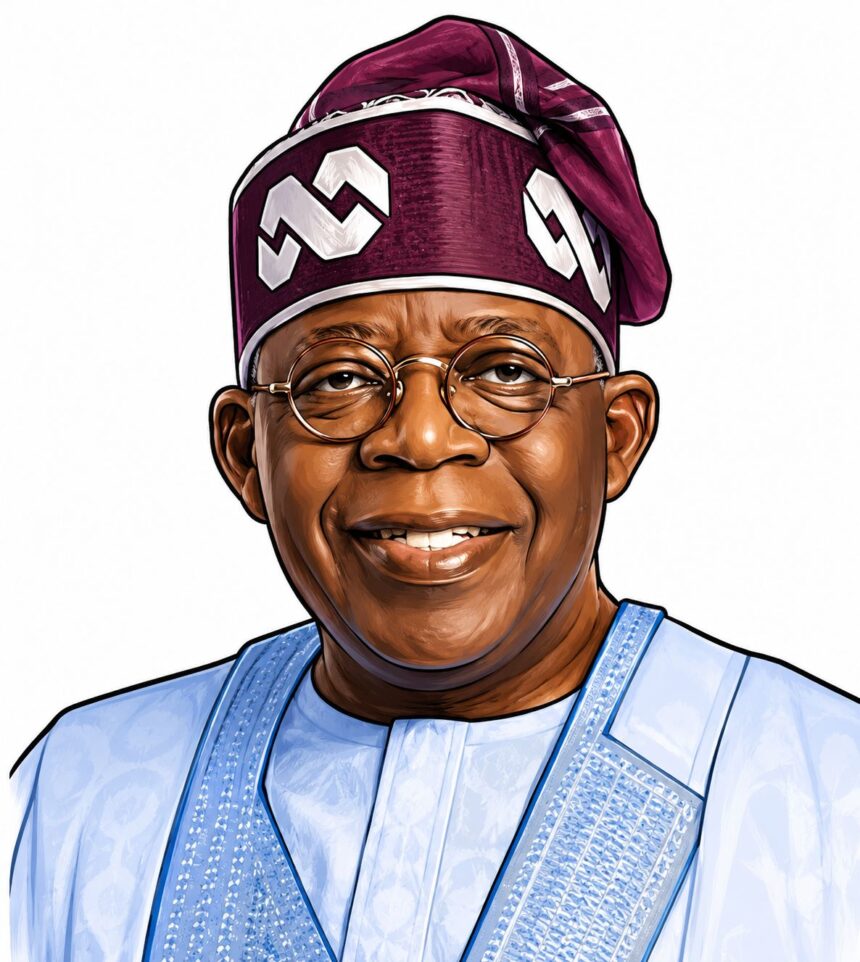
REFORM TALKS with President Bola Tinubu
In this release from the Nigerian Presidency, which we have elected to publish in parts, President Bola Ahmed Tinubu outlines the Federal Government’s infrastructure investment strategy, explaining how policy changes, productive borrowing and long-term capital investment are expected to advance Nigeria’s ambition of building a $1 trillion economy.
Since 2023, we have made difficult but necessary decisions: removing the petrol subsidy, unifying the exchange rate, modernising the tax framework, and coordinating action on inflation. These reforms have restored macro balance, quadrupled federation revenue since 2021 and rebuilt the credibility of the State’s balance sheet. The results are now visible: real GDP growth reached 4.43% in Q2 2026 and 4.2% in H1, up from 2.74% in 2023, while headline inflation fell to 14.63% in September 2026 from 20.98% a year earlier.
Food inflation, while still elevated, stood at 19.59%. Gross external reserves reached USD 55.1 billion as of 9 October 2026, including about USD 46 billion in net reserves, an 18-year high. The NFEM exchange rate stood at N1,333/US$, with the market spread below 5%, and public debt remains low compared to peers. Nigeria’s cost of borrowing keeps falling. Confidence has a price, our cost of borrowing is going down, and the country risk premium has drastically decreased.
This changes the purpose of public borrowing. The objective is to increasingly direct new borrowing towards productive capital investment, while maintaining fiscal discipline, reducing refinancing pressures and ensuring that public debt translates into measurable economic value. Nigeria borrows to invest in roads, ports, rail and power that will generate growth, revenue and jobs for decades.
Every naira and every dollar raised goes to assets that create value, and that value repays the debt. This is how Nigeria will reach the objective of a USD 1 trillion economy by 2030: not through consumption, but through investment in the infrastructure that makes growth possible. This shift is being supported by a stronger fiscal position: tax-to-GDP has risen to 12.5% from 7%, net FAAC increased by 44% from N15.2 trillion in 2024 to N21.9 trillion in 2025, and Nigeria recorded a N20.1 trillion trade surplus in H1 2026, almost double the N10.2 trillion recorded in H1 2025.
Borrowing to build, not to bridge, not for consumption:
Nigeria is fundamentally changing the purpose of public borrowing: from financing short-term fiscal pressures to investing in assets that will transform the economy for generations. This shift is taking place with public debt at 35.75% of GDP in Q2 2026 and debt service at about 65% of revenue in H1 2026, underscoring why investment must remain anchored in fiscal discipline. Nigeria election analysis
The Federal Executive Council economic strategy is clear on this point: no deficit monetisation and no unfunded commitments during the pre-election period. At the heart of this disciplined shift towards productive borrowing are our administration’s legacy projects:
The administration is focusing productive borrowing on financing major infrastructure projects, including the Lagos–Calabar Coastal Highway; improvements to the power sector and electricity grid; the Sokoto–Badagry Superhighway; the Trans-Sahara Superhighway; and upgrades to Nigeria’s major commercial ports in Lagos.
Together with other priority projects, the rehabilitation of key hospitals, and investment in education and vocational training, these investments are game-changing. They will connect entire economic regions, unlock agricultural and industrial potential, reduce logistics costs, attract private investment and create hundreds of thousands of direct and indirect employment opportunities over time.
Delivery is already visible on the Lagos-Calabar highway as a major transport infrastructure project as of August 2026. Lot 2 was reported to be over 80% complete, while Calabar–Akwa Ibom works were over 30% complete. This increased emphasis on investment is also evident at the subnational level, where the share of state spending devoted to capital expenditure rose from 46% in 2023 to 61% in 2025.
This is not simply about building infrastructure. It is about reshaping Nigeria’s economic geography, unlocking new sources of growth and creating the productive capacity to achieve a USD 1 trillion economy. The debt is finite; the economic value these assets can generate will endure for generations.
Value for money and impact on growth:
The legacy projects are selected and financed on value addition: what they return to the economy for every Naira spent. They connect production to markets, ports to the hinterland and Nigeria to its neighbours. The Lagos–Calabar Coastal Highway alone is expected to reduce logistics costs by 15–20% along the corridor and could add up to 2% to Nigeria’s GDP through new industrial zones, trade and tourism.
These projects are also among the largest job creators in the country. The Coastal Highway is expected to generate around 100,000 direct jobs in construction and engineering and more than 150,000 indirect jobs in logistics, materials and services.
Across the Sokoto–Badagry and Trans-Sahara corridors, the same logic applies to the enhancement of the power grid, ports, rail lines, and social infrastructure: jobs during construction, and lasting employment in the industries, farms, and businesses that grow along the routes once they open.
Lower transport costs mean lower food prices, more competitive exports and stronger revenue for the State. That is value for money: assets that pay back through growth, jobs and revenue, financed over a horizon that matches their life, and each one a step towards the USD 1 trillion economy.
Long-term commitments for long-term assets:
The structure of Nigeria’s debt now matches the nature of what it finances. The government is extending the maturity profile and shifting from short-term borrowing to long- and very long-term maturities at lower cost. Infrastructure built to last forty years should be financed over a horizon consistent with its life. International investors are willing to commit to Nigeria over ten, fifteen years and beyond, which is the clearest signal of confidence in the country’s trajectory. The broader financing environment is also benefiting from monetary easing: the Monetary Policy Rate was cut by 350 basis points on 22 September 2026, from 26.5% to 23%.
Yet lending rates remain above 30%, reinforcing the need to secure longer-tenor, more competitive financing for productive investment.
President Tinubu is President of Federal Republic of /Commander-in-Chief of the Armed Forces of the Federal Republic of Nigeria