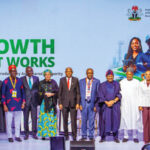

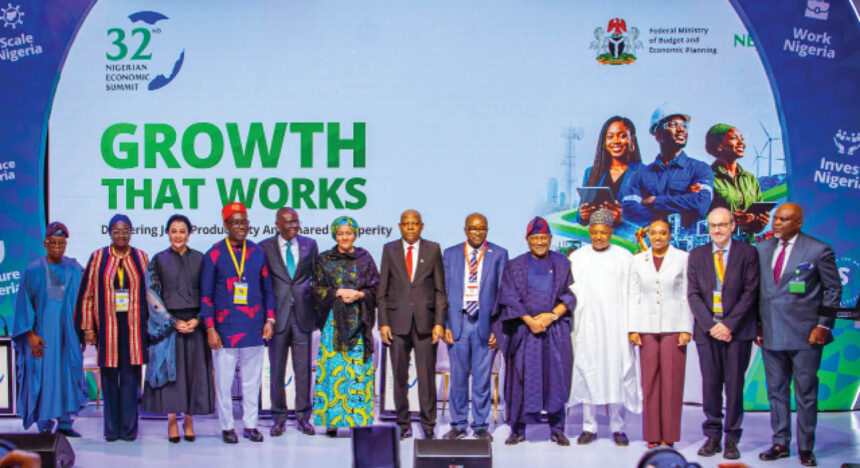
Nigeria’s economic recovery is gaining momentum, but translating growth into jobs, productivity and improved living standards remains a critical challenge. At the 32nd Nigerian Economic Summit, President Bola Tinubu defended his administration’s reforms as the foundation for sustainable growth, while business leaders and development partners called for stronger implementation, policy stability and measurable economic outcomes. Enam Obiosio writes…
Nigeria’s economic recovery is facing a critical test: whether improving growth figures and renewed investor confidence can translate into productive jobs, stronger businesses and better living standards. At the 32nd Nigerian Economic Summit in Abuja, President Bola Tinubu defended his administration’s economic reforms as a necessary departure from decades of underperformance. Yet the central challenge extends beyond stabilising the economy. It is whether the reforms can deliver inclusive growth in an economy where recovery must be measured not only by capital inflows and GDP expansion, but by their impact on livelihoods.
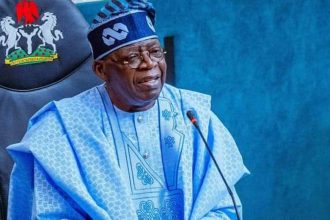
Represented by Vice President Kashim Shettima, the President said the administration was determined to dismantle structural barriers that had prevented Nigeria from realising its economic potential.
“We came to rewrite the story of a nation that has performed below its potential for far too long. But there is no shortcut to economic growth,” the President said.
He argued that the difficult economic reset was necessary to stabilise the economy, restore confidence and create conditions for businesses to invest, expand and generate productive employment.
“For us, rescuing the economy means rescuing livelihoods and transforming the fortunes of young jobseekers, farmers, manufacturers, entrepreneurs and innovators,” he said.
The administration’s argument rests partly on improving economic indicators. According to figures from the National Bureau of Statistics (NBS) cited by Tinubu, Nigeria’s inflation-adjusted gross domestic product grew by 3.89 percent in the first quarter of 2026, compared with 3.13 percent in the corresponding period of 2025.
The President also cited non-oil activities’ contribution of 96.08 per cent to GDP, alongside manufacturing growth of 3.29 per cent and oil sector growth of 2.57 percent.
These figures point to an economy increasingly driven by non-oil activity. However, aggregate growth does not automatically establish that households are experiencing improved purchasing power or that businesses are creating sufficient quality employment.
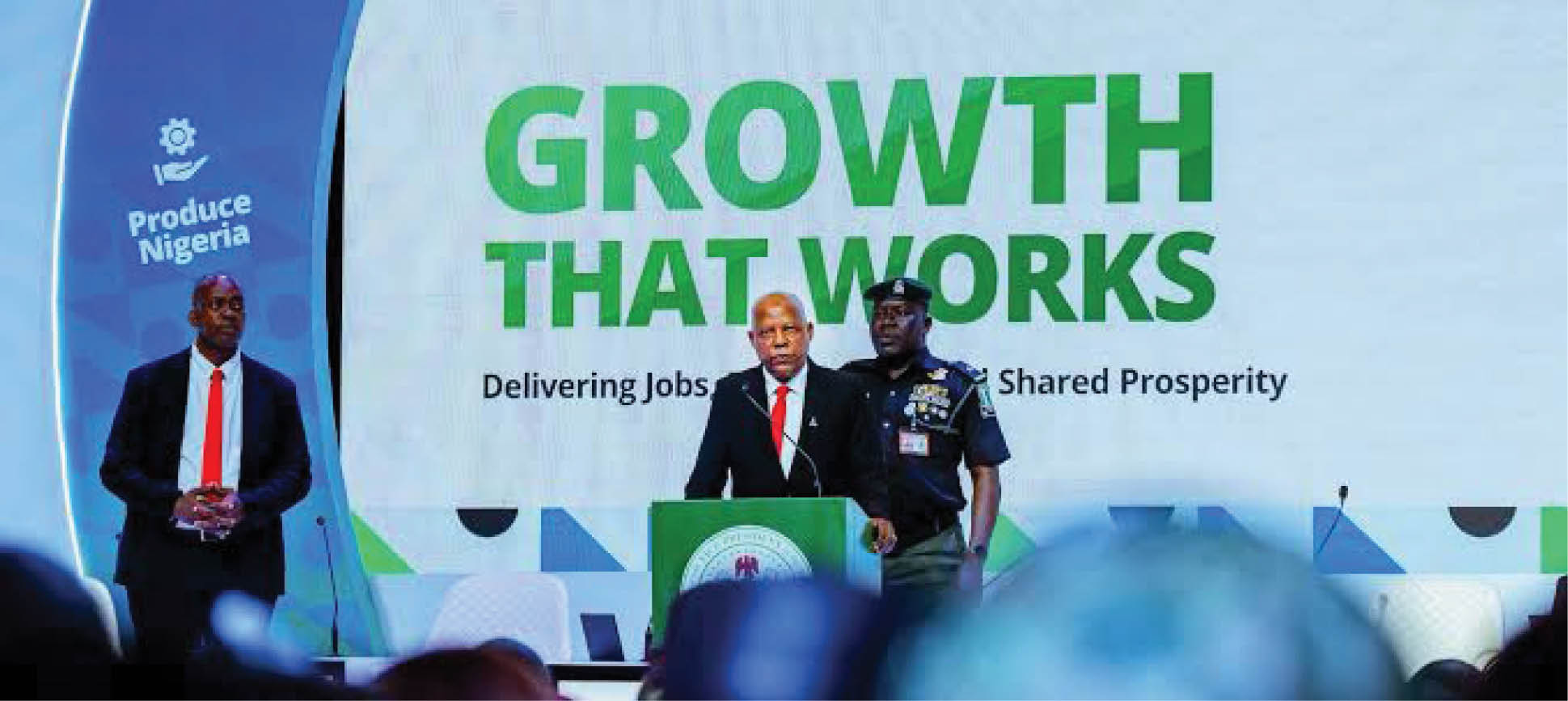
Tinubu acknowledged this distinction, stressing that job creation alone would not be enough to deliver inclusive prosperity.
“We must improve the quality of work, reduce underemployment and harness the potential” of Nigeria’s underutilised workforce, he said.
His remarks placed productivity at the centre of the administration’s economic ambitions. Tinubu argued that infrastructure should be judged by the economic activity it generates, education by the skills and productivity it delivers, and industrial policy by the competitiveness of businesses.
The government also pointed to rising capital inflows as evidence of improving investor confidence. Tinubu said capital importation reached $10.37 billion in the first quarter of 2026, representing an 83.83 percent increase over the corresponding period in 2025.
He said the administration would continue to ease regulatory burdens, improve transparency and policy predictability, and expand access to finance.
Yet the investment figures also raise a broader question about how effectively capital inflows can be converted into domestic production, employment and wider economic benefits.
The government’s proposed interventions span taxation, electricity, agriculture and solid minerals. Tinubu said tax reforms were intended to create a more equitable system that finances development while providing businesses with greater certainty.
In agriculture, he said the administration was connecting farms to storage facilities, processing centres and markets while expanding irrigation, mechanisation and rural infrastructure. In the solid minerals sector, the government intends to move beyond extraction towards domestic processing, industrial production and exports.
These commitments reflect an ambition to strengthen the productive base of the economy. Their impact, however, will depend on implementation, financing and the ability to address persistent constraints facing enterprises.
From reform to implementation
Dr. Amina Mohammed, United Nations Deputy Secretary-General, acknowledged the gains of the administration’s reforms but urged their consolidation and stabilisation. She also stressed the importance of managing expectations among citizens and other stakeholders.
Her assessment highlights a central challenge facing the economic recovery: sustaining policy direction while ensuring that the costs and benefits of adjustment are understood and managed.
Chairman of the Nigerian Economic Summit Group (NESG), Olaniyi Yusuf, similarly argued that the priority should be stabilisation rather than policy reversal.
Yusuf said the summit must help Nigeria move beyond policy consensus towards practical solutions, with deliberations focused on job creation, productivity and shared prosperity.
This position was reinforced by BUA Group Chairman and Founder Abdul Samad Rabiu, who commended the reforms for addressing longstanding business challenges.
Rabiu acknowledged the difficulties confronting ordinary Nigerians but said improved foreign exchange access had created a more predictable environment for businesses.
“For many years, one of the greatest challenges facing businesses was access to foreign exchange. You could have all the naira but be unable to obtain the foreign exchange needed to buy raw materials and machinery,” he said.
His remarks underscore the importance of currency stability and access to foreign exchange for domestic production. However, a more predictable business environment must also translate into expanded investment, competitive production and employment opportunities.
Meanwhile, Finance Minister and Coordinating Minister of the Economy, Dr. Taiwo Oyedele, presented the proposed Nigerian Economic Policy Framework, describing it as a national economic doctrine for guiding economic decisions and measuring progress.
He invited the NESG and private sector experts to scrutinise the draft with facts and figures. The framework’s proposed principles include enterprise, open but fair markets, and whole-of-government coherence, with economic stability, human capital development and productivity among its focus areas.
The summit’s theme, ‘Growth That Works: Delivering Jobs, Productivity and Shared Prosperity,’ captures the next stage of Nigeria’s economic challenge.
The Tinubu administration has presented evidence of improving growth, diversification and capital inflows. Business leaders have acknowledged improvements in the operating environment, while development partners have called for consolidation.
The decisive measure, however, will be whether these gains translate into better jobs, stronger purchasing power, more competitive businesses and broader access to economic opportunity.
For Nigeria, the challenge is no longer simply to demonstrate economic growth. It is to ensure that growth delivers prosperity beyond the figures.