Nigeria’s latest growth figures tell a story that is bigger than a stronger gross domestic product (GDP) number. The economy expanded by 4.43 percent in the second quarter (Q2) of 2026, its strongest quarterly performance since Q3 2024, as services, agriculture and oil activity gained momentum. The improvement adds weight to the argument that the economy is emerging from a period of weak growth and macroeconomic instability. But the next chapter will be harder. Sustaining the momentum, reviving industrial productivity and ensuring that stronger output translates into jobs, investment, higher incomes and lower costs will determine whether Nigeria’s recovery becomes meaningful prosperity for its citizens. Enam Obiosio writes…
The National Bureau of Statistics (NBS) reported that Nigeria’s real Gross Domestic Product (GDP) grew by 4.43 percent year-on-year in Q2 2026. The figure is higher than the 4.23 percent recorded in the same quarter of 2025 and represents an improvement from the 3.89 percent growth recorded in Q1 2026.
It is the strongest quarterly growth recorded since Q3 2024, when the economy expanded by 3.86 percent.
The progression is significant because it shows that the economy is not merely avoiding contraction. It is gradually building a stronger rate of expansion.
Annual growth tells the same story. According to NBS data, the economy grew by 0.95 percent in 2021, accelerated to 4.32 percent in 2022, slowed to 3.04 percent in 2023, and then recovered to 3.38 percent in 2024 and 3.87 percent in 2025.
The Q2 performance therefore extends a trajectory that has been developing over the past two years.
Yet the number itself should not be mistaken for the destination.
President Bola Ahmed Tinubu has repeatedly expressed the ambition of taking annual economic growth towards 7 percent by 2027. At 4.43 percent, quarterly growth is encouraging, but the economy still needs a stronger and more sustained expansion to meet the scale of growth required to significantly alter living standards in a country with a rapidly growing population.
That makes the composition of the latest growth particularly important.
Services continue to carry the largest share of the economy, contributing 56.62 percent of real GDP in Q2. The sector also grew by 4.60 percent, compared with 3.94 percent in the corresponding quarter of 2025.
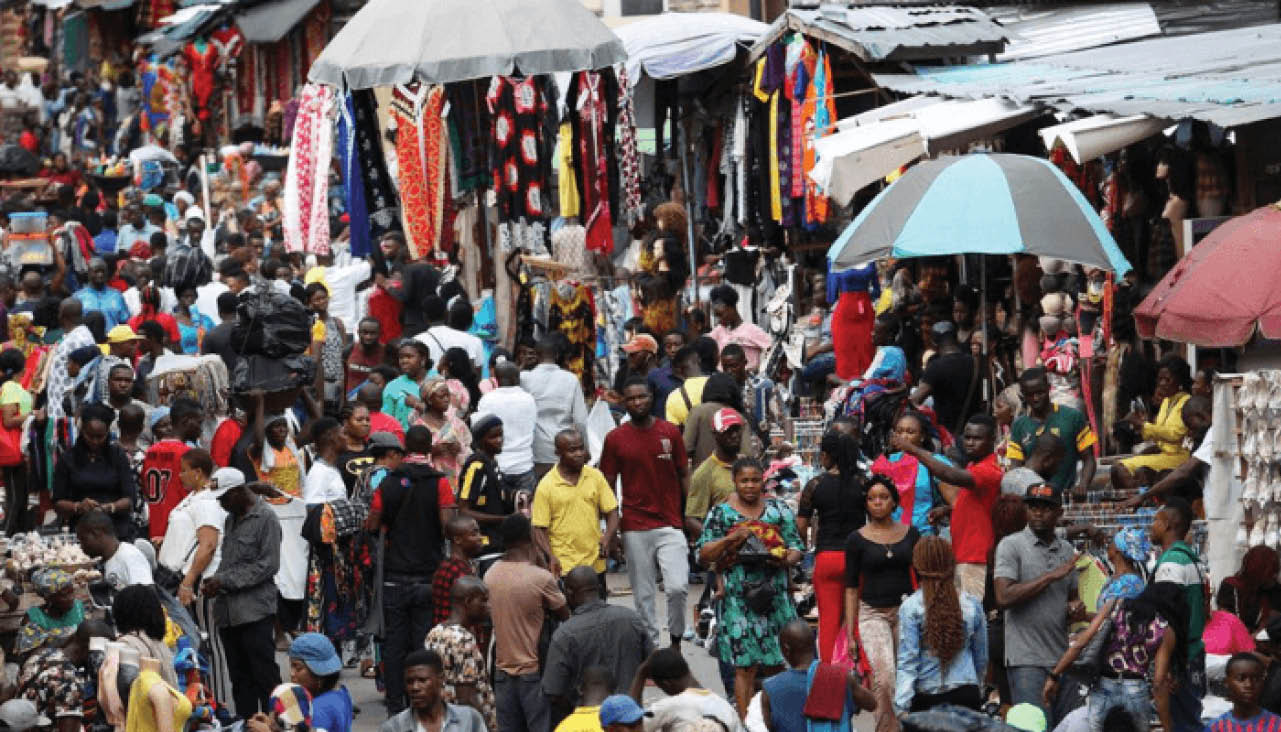
The dominance of services reflects the structural character of Nigeria’s economy. Information and communication, financial services, trade, real estate and other service activities are increasingly central to economic activity. Their performance suggests that growth is being supported by a broad range of businesses beyond the traditional oil economy.
Agriculture also delivered a stronger performance. The sector contributed 26.15 percent of real GDP and grew by 4.39 percent, substantially above the 2.82 percent recorded in Q2 2025.
That improvement matters beyond the GDP table. Agriculture remains deeply connected to employment, food supply and rural incomes. Stronger agricultural output can therefore have a wider economic effect, particularly if increased production eventually helps moderate food pressures and creates more opportunities along agricultural value chains.
But the sector continues to operate under considerable constraints, including insecurity, high input costs, climate pressures and inadequate infrastructure. Sustaining the current growth rate will require more than favourable output figures. It will require productivity gains and stronger links between farms, processors, markets and consumers.
The industrial sector presents a different picture. Industry grew by 3.96 percent in Q2 2026, compared with 7.46 percent in the corresponding period of 2025. Its contribution to real GDP stood at 17.23 percent.
This is one of the clearest qualifications to the otherwise positive GDP report.
Nigeria cannot achieve durable, broad-based economic transformation through services and agriculture alone. Industrial expansion is essential for manufacturing, construction, job creation, exports and domestic production. A slowdown in industrial growth therefore points to the structural constraints that still need attention.
Electricity supply, access to affordable finance, logistics, infrastructure and production costs remain critical factors determining whether Nigerian businesses can expand their productive capacity.
The oil sector, meanwhile, provided another boost to the quarter.Average daily crude oil production increased to 1.72 million barrels per day (bpd) from 1.55 million bpd in Q1 2026. It was also higher than the 1.68 million bpd recorded in Q2 2025.
The improvement in production was reflected in oil-sector growth. The sector expanded by 7.31 percent year-on-year, compared with 2.57 percent in Q1. On a quarter-on-quarter basis, oil-sector growth reached 10.91 percent.
For a country where crude oil remains important to foreign exchange earnings and public revenue, higher production provides additional fiscal and external support.
Yet the structure of the economy tells an equally important story. Oil contributed only 4.16 percent of real GDP in Q2, while the non-oil sector accounted for 95.84 percent.
The non-oil economy itself grew by 4.31 percent, compared with 3.64 percent a year earlier and 3.94 percent in the preceding quarter.
Agriculture, information and communication, real estate, trade, financial and insurance services, manufacturing and construction were among the activities supporting this expansion.
This is perhaps the most important feature of the latest GDP report. Nigeria’s economic growth is increasingly being generated outside crude oil.
The challenge now is to make that non-oil expansion deeper, more productive and more inclusive.
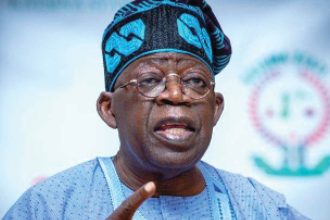
President Tinubu, in his reaction to the NBS report on August 31, linked the latest figures to the economic direction of his administration.
“In the past three years, we tried to do the hard part by implementing the necessary reforms to stabilise the economy. Now the economy is stabilised, and we have laid the foundation for a prosperous nation,” he said.
The President argued that the effects of the administration’s decisions were becoming increasingly visible, pointing to stronger external reserves, improved credit ratings, higher oil production, infrastructure investment and the return of investors.
“The results of the efforts are becoming very clear to all: The Renewed Hope Agenda is working,” President Tinubu stated.
He also acknowledged that macroeconomic improvement must eventually be felt at the household level.
“We are fully committed to translating consistent, stronger economic performance into better microeconomic outcomes for our citizens,” the President said.
That distinction between macroeconomic performance and household experience is central to understanding the latest figures.
A growing GDP does not automatically mean that Nigerians are becoming wealthier. Economic output can rise while households continue to struggle with high prices, weak purchasing power or limited employment opportunities.
The N119.29 trillion nominal GDP recorded in Q2 2026, compared with N100.7 trillion in Q2 2025, illustrates the scale of the economy in current prices. But what ultimately matters to citizens is how much economic value translates into real income and improved access to goods and services.
For businesses, the question is equally practical. Can stronger growth translate into cheaper financing, more reliable electricity, better infrastructure, improved logistics and a larger consumer market?
For government, the next phase is therefore more demanding than simply sustaining a positive GDP headline.
The foundations of stability must now support productivity.
Higher oil production needs to be accompanied by continued investment in the non-oil economy. Stronger agricultural output needs better storage, processing and market access. The service sector needs an environment that supports innovation and investment. Industry needs reliable energy, infrastructure and financing to regain the momentum reflected in last year’s figures.
The latest NBS report provides evidence that Nigeria’s economy is moving forward. The 4.43 percent expansion is stronger than both the previous quarter and the corresponding quarter of last year. It also sits within a broader pattern of improving annual growth.
But the real test begins beyond the GDP headline. Nigeria needs growth that is sustained, productive and capable of reaching households. It needs an economy where stronger output creates jobs, investment expands productive capacity and businesses can compete at lower costs.
The Q2 figures suggest that the economy is gaining speed. The next task is to ensure that the momentum becomes durable and that the benefits move from the national accounts into factories, farms, businesses and, ultimately, the pockets of Nigerians.