By. Majeed Salaam
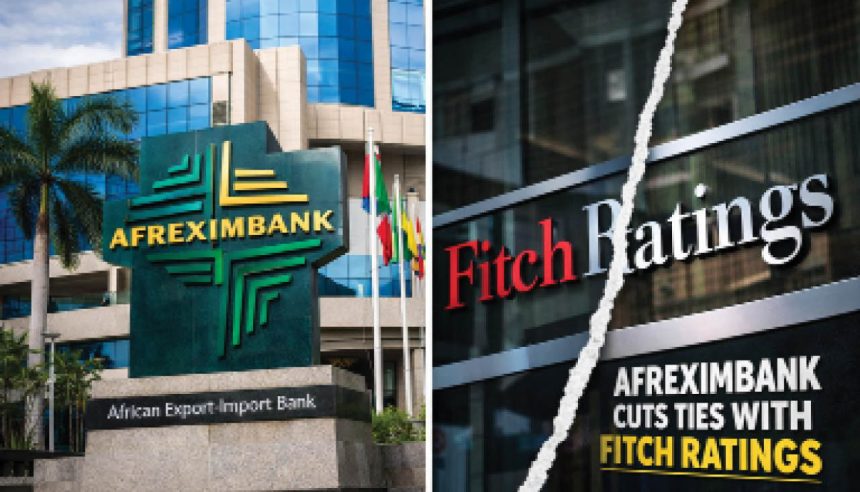
When the African Export-Import Bank (Afreximbank) quietly severed its credit rating relationship with Fitch Ratings, it was more than a technical dispute between a lender and a ratings agency. It was a signal moment in Africa’s long-running struggle over how its institutions are assessed, priced, and understood in global financial markets.
In a statement released on January 23, Afreximbank said that it had formally ended its engagement with Fitch Ratings after concluding that the agency’s assessment framework no longer reflected the bank’s unique legal foundation, mandate, or development-focused mission. The decision followed what the Cairo-based lender described as a comprehensive internal review of its relationship with the ratings firm.
At the core of Afreximbank’s concern is a familiar complaint across the continent, that global credit assessment models often flatten African institutions into generic risk profiles, overlooking legal protections, governance structures, and policy roles that do not fit neatly into conventional templates.
“This decision follows a review of the relationship, and its firm belief that the credit rating exercise no longer reflects a good understanding of the Bank’s Establishment Agreement, its mission, and its mandate,” the bank said.
A Mandate That Defies Easy Categorisation
Unlike commercial banks or sovereign borrowers, African Export-Import Bank occupies a hybrid space. It is a multilateral development finance institution, owned by African states, central banks, and private investors, with a treaty-based Establishment Agreement that grants it specific legal protections and privileges across its member countries.
Those protections, Afreximbank argues, materially alter its risk profile. Its Establishment Agreement has been signed and ratified by participating states, embedding legal immunities and creditor safeguards that are not easily captured by standard sovereign or bank-rating methodologies. From the bank’s perspective, treating it as just another financial institution misses the point.
That frustration appears to have reached a tipping point.
While Afreximbank did not publicly dissect Fitch’s analytical assumptions line by line, its message was clear, that the ratings process, as currently applied, does not adequately reflect the bank’s foundational architecture or its role as a policy-driven lender supporting African trade and development.
Resilience Without the Rating
Importantly, Afreximbank was careful to stress that the decision does not signal financial weakness. On the contrary, it emphasised that its business profile remains strong, underpinned by robust shareholder relationships and the legal and institutional safeguards built into its structure.
In recent years, the bank has expanded its balance sheet significantly, stepping in as a countercyclical financier during periods of global stress, from pandemic-era trade disruptions to tightening international capital markets. It has financed intra-African trade, supported balance-of-payments needs, and played a visible role in advancing the objectives of the African Continental Free Trade Area.
That track record, Afreximbank suggests, speaks more clearly to its resilience than a rating framework it believes is misaligned with its reality.
The bank also reaffirmed its commitment to transparency, sound financial management, and stability, signalling that disengaging from Fitch does not mean disengaging from market discipline. What it does mean is a refusal to accept an assessment it considers structurally flawed.
To Re-Rate or Not to Re-Rate
Notably, Afreximbank did not indicate whether it plans to appoint another international credit rating agency in the near term. That silence leaves open several possibilities.
It may choose to engage a different agency, hoping for a methodology it considers more attuned to multilateral development institutions. Alternatively, it may rely more heavily on direct investor engagement, disclosures, and its treaty-based protections to sustain market confidence.
Either path carries implications. Credit ratings still matter in global capital markets, shaping investor mandates, pricing, and access. Walking away from one agency is not cost-free. But neither is accepting a rating that an institution believes systematically understates its strengths.
A Broader African Debate
Beyond Afreximbank itself, the decision has reopened a wider debate about how African risk is measured and who controls that narrative.
For decades, African sovereigns and institutions have argued that global rating agencies apply frameworks developed primarily for advanced economies, often amplifying downside risks while underweighting structural safeguards, policy intent, and reform trajectories. Critics contend that this bias feeds a vicious cycle, lower ratings raise borrowing costs, higher costs constrain development, and constrained development reinforces perceptions of risk.
Afreximbank’s move gives institutional weight to that critique. As a multilateral lender rather than a sovereign borrower, its challenge is not about national politics or fiscal slippage, but about whether development-focused mandates can be fairly evaluated within existing rating paradigms.
What Comes Next
Markets will now watch closely. Investors will assess whether Afreximbank’s balance sheet strength, governance, and shareholder backing continue to compensate for the absence of a Fitch rating. Other African institutions may also study the episode, weighing whether engagement, reform, or disengagement is the most effective way to address perceived misalignment with rating agencies.
For Afreximbank, the message is already set. It is not rejecting scrutiny; it is rejecting a framework it believes fails to understand what the bank is, why it exists, and how it is designed to operate.
In an era of tight global liquidity and shifting capital flows, that distinction matters. Because in the end, the debate is not only about ratings. It is about whether African institutions can insist on being assessed on their own terms, rather than through lenses that were never built for them in the first place.