By Jennete Ugo Anya
The Bank of Industry (BOI) has spotlighted the twin challenges of limited funding and inadequate technical know-how as the biggest obstacles preventing Nigeria’s micro, small, and medium enterprises (MSMEs) from fully adopting Environmental, Social, and Governance (ESG) principles.
The revelation came during the launch of the bank’s report titled ‘Environmental, Social and Governance Adoption by Nigerian Micro, Small and Medium Enterprises’, unveiled at BOI’s inaugural ESG Conference in Lagos.
The event, themed ‘Advancing ESG Adoption’, brought together policymakers, development partners, and private sector stakeholders committed to accelerating Nigeria’s sustainable business transition.
According to the report, over 78 percent of surveyed MSMEs lamented financial limitations, while 65 percent identified a lack of technical expertise as a significant impediment to implementing ESG frameworks in their operations. The survey, which cut across Nigeria’s six geopolitical zones, captured insights from over 300 enterprises across sectors such as agro-processing, ICT, manufacturing, healthcare, creative industries, and financial services.
The findings also revealed that 65 percent of respondents cited the absence of ESG-linked incentives, 45 percent acknowledged low awareness, and 20 percent pointed to minimal customer demand for sustainable products and practices. An indication that market forces alone are not enough to drive ESG adoption.
To address these gaps, the BOI report recommended a set of actionable interventions – from ESG-compliant financial products with flexible loan features to gender-focused credit windows aimed at narrowing the adoption gap for women entrepreneurs. It also proposed regional capacity-building hubs to enhance technical expertise and the use of blended finance models to increase access to green capital.
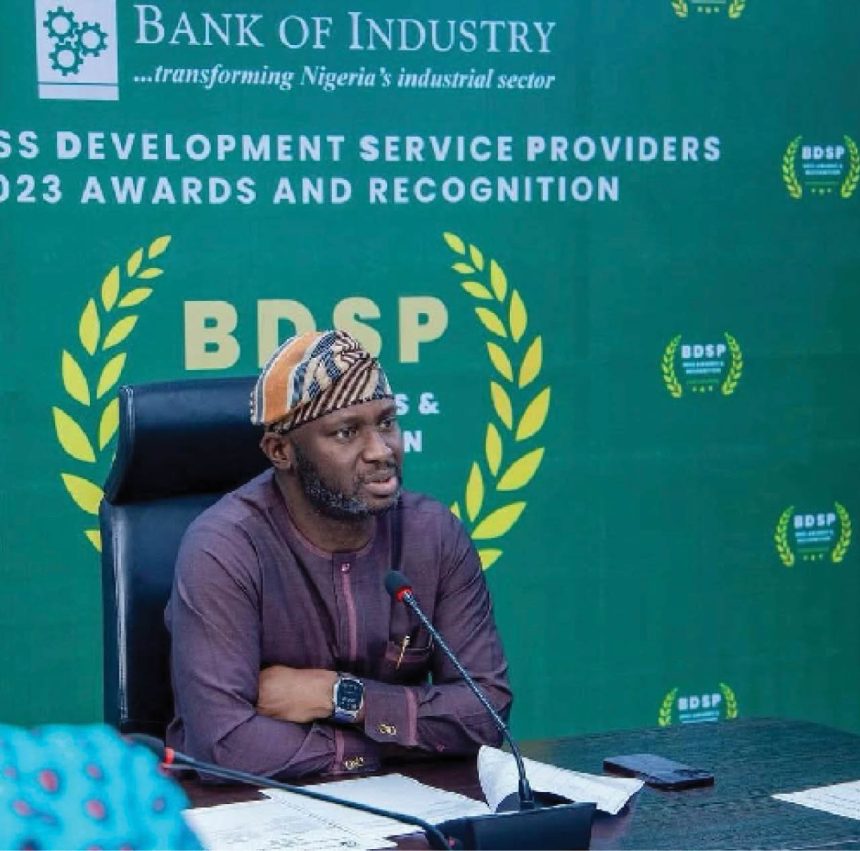
Speaking at the conference, Dr. Olasupo Olusi, BOI’s Managing Director (MD)/Chief Executive Officer (CEO), underscored the critical role MSMEs play in Nigeria’s economy, accounting for over 80 percent of businesses and nearly half of the national gross domestic product (GDP).
“Despite their importance, many MSMEs still struggle to understand what ESG means in practice and how to integrate these principles into their daily operations,” Dr. Olusi noted. “This limits their competitiveness, resilience, and readiness for the global marketplace.”
He stated that BOI’s ESG drive aligns with Nigeria’s climate commitments under the Paris Agreement, Nationally Determined Contributions, and Energy Transition Plan, which targets a 47 percent conditional emission reduction by 2030.
“ESG adoption is more than a compliance issue – it’s a growth strategy,” Dr. Olusi said. “It improves access to finance as global investors increasingly prioritise sustainability. It also helps businesses manage risks, reduce costs, attract top talent, and align with international standards.”
He emphasised that embracing ESG principles would not only attract green capital and spur innovation but also lay the foundation for Nigeria’s industrialisation through clean energy, efficient resource use, and responsible governance.
Delivering the keynote address, the Director-General of the National Council on Climate Change, Tenioye Majekodunmi, described ESG adoption as a defining factor in how Nigerian enterprises will compete in a rapidly transforming global economy.
“Climate realities and shifting investor expectations are redrawing the map of competitiveness,” she said. “Businesses that embed sustainability early will be the preferred partners for global trade and finance.”
Majekodunmi commended the BOI’s ESG framework for MSMEs, describing it as a “national blueprint” for aligning financial systems with sustainable and inclusive growth. “By linking its lending to ESG principles, the BOI is setting a new benchmark that will open green finance windows to Nigerian enterprises,” she added.
In a show of support from development partners, Mahamadou Diarra, Deputy Country Director of Agence Française de Développement (AFD) Nigeria, praised the BOI for its leadership in integrating ESG into the financial ecosystem.
“BOI’s initiative strengthens Nigeria’s position as a responsible player in the global financial system,” Diarra stated. “It builds trust among international financiers and harmonises local standards with global ESG due diligence frameworks.”
He reaffirmed AFD’s commitment to supporting the BOI in scaling climate-related investments and deepening ESG management practices across Nigeria’s development finance landscape.
As Nigeria strives to meet its climate goals and attract sustainable investment, the BOI’s ESG report provides both a wake-up call and a roadmap – urging stakeholders to close the financing and knowledge gaps that continue to hold back MSMEs from leading the nation’s sustainability transition.