

By Jennete Ugo Anya
Nigeria’s economic debate has long centered on population and market potential, but at a recent Lagos economic summit, the federal government shifted focus to production. The message was clear: Nigeria must make what it uses.
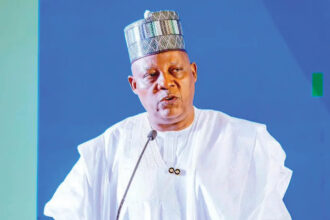
At the Redeemed Christian Church of God Lagos Province 35 Economic Summit, Honourable Minister of State for Industry, Mr. John Owan, said that demography without industry is not an advantage but a risk. For the Presence administration, the goal is turning Nigeria’s population and market size into factories, jobs, and value chains.
At the center of this effort is the ‘Nigeria-First’ policy, launched in 2025 by President Bola Ahmed Tinubu. The policy prioritizes Nigerian-made goods and services in public procurement, using government demand to drive domestic manufacturing. Mr. Owan emphasized that announcing a policy is one thing, but effective execution will determine its success.
Procurement as Industrial Policy
The federal government’s strategy is a renewed focus on public procurement as an industrial lever. Mr. Owan disclosed that his ministry has begun structured engagements with the Bureau of Public Procurement (BPP), targeting key sectors where Nigeria already has latent capacity. These include textiles and apparel, automotive assembly, medical equipment, furniture, and other labour-intensive manufacturing segments.
Public procurement, he argued, remains one of the most underutilised tools of industrial policy in Nigeria. Predictable government demand, if properly structured, can de-risk private investment, encourage scale, and anchor local value chains.
“When government demand is predictable, investors respond,” Mr. Owan said. “That is how you unlock private capital and accelerate domestic production.”
The logic is straightforward. Ministries, departments, and agencies (MDAs) are among the largest buyers in the Nigerian economy. Aligning their purchasing power with industrial goals can reshape markets faster than subsidies or incentives alone.
Lessons from Elsewhere
Mr. Owan’s argument draws from global experience rather than abstract theory. He cited countries such as Bangladesh and Vietnam, which built export-oriented manufacturing sectors not by waiting for perfect infrastructure, but by creating predictable policy environments and focusing on specific value chains.
“Bangladesh became a global leader in garments not because everything was perfect,” he said. “It built competitiveness, predictability, and focus. Vietnam followed a similar path and now exports electronics, garments, and machinery to the world.”
For Nigeria, the lesson is not imitation, but adaptation. Large populations do not automatically generate prosperity. They do so only when labour is absorbed into productive systems.
“A huge population only makes sense if it is productive,” Mr. Owan warned. “Otherwise, it becomes pressure, not potential.”
The Automotive Example
Few illustrations captured the minister’s thinking more clearly than his remarks on the automotive sector. He described how government meetings often resemble “an international motor fair for Toyota,” a reflection of how deeply imported vehicles dominate official fleets.
Yet Nigeria remains one of Toyota’s largest markets globally. In Mr. Owan’s view, that market power should translate into local investment.
“If you gave Toyota one or two years and said, unless you establish plants in Nigeria, no government agency would buy Toyota, it would make sense,” he said. “The Nigerian market remains key.”
The point is not to single out one company, but to demonstrate how procurement conditions can incentivise local assembly, technology transfer, and job creation, without breaching global trade rules.
What Businesses Are Asking For
During consultations with manufacturers across the country, Mr. Owan said a consistent message has emerged from the private sector, one that challenges popular assumptions about investment.
“One manufacturer told me very clearly, ‘I don’t need everything to be perfect; I just need things to be predictable,’” he said.
That sentiment, according to the minister, captures the essence of industrial competitiveness. Entrepreneurs innovate when rules are stable. Investors commit capital when policy direction is clear. Manufacturers expand when planning horizons are reliable.
“Predictability is the foundation of competitiveness,” Mr. Owan said. “Without it, businesses spend more time coping with uncertainty than investing in growth.”
For the federal government, this means shifting away from discretionary, consumption-driven interventions toward a rule-based, production-oriented framework, where policy signals are consistent and credible.
Demography as a Deadline
Nigeria’s youthful population is often framed as a dividend. He offered a more sobering interpretation. Without rapid industrial expansion, the same demographic profile could become a liability. “Youth without jobs is not a dividend,” he said. “A large population only makes sense if it is productive.”
The urgency is clear. Manufacturing absorbs labour at scale, creates linkages across agriculture, logistics, and services, and generates skills that compound over time. Without it, Nigeria risks entrenching unemployment and underemployment, with social and fiscal consequences.
Aligning Policy, Procurement, and Production
What distinguishes the current push, Mr. Owan argued, is the attempt to align industrial policy with procurement reform. Instead of treating manufacturing as a standalone agenda, the government is linking demand, rules, and production decisions. “We are aligning policy, procurement, and production,” he said. “That is how we convert demography into demand, demand into production, and production into jobs.”