
By Anita Dennis
Nigeria has taken another step toward addressing long-standing mechanisation gaps in its agricultural sector, as two federal institutions signed a new agreement aimed at expanding farmers’ access to machinery through structured leasing systems.
The National Agricultural Development Fund and the Equipment Leasing Registration Authority (ELRA) have entered into a Memorandum of Understanding (MoU) designed to improve availability of tractors, harvesters, irrigation systems, processing machines and other key agricultural equipment across the country.
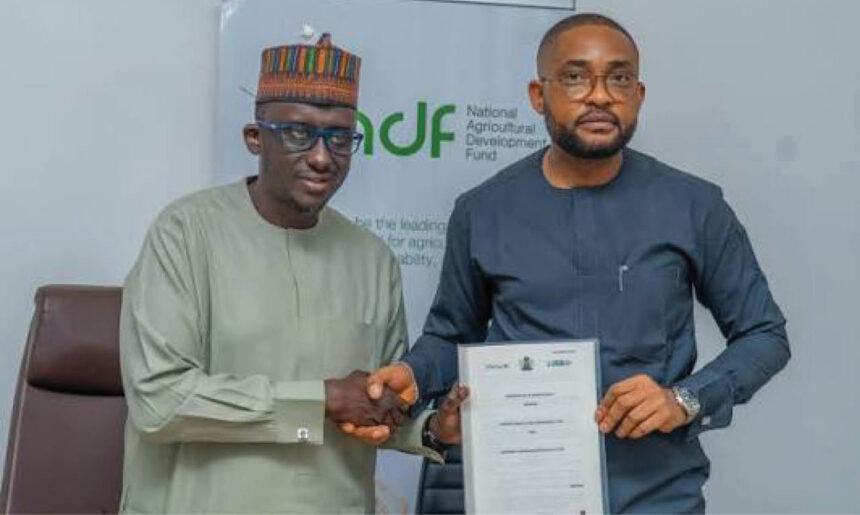
The agreement was signed in Abuja by ELRA’s Registrar and Chief Executive Officer, Mr. Donald Wokoma, and the Executive Secretary of NADF, Mr. Mohammed Ibrahim. It is expected to serve as a framework for expanding access to mechanised farming tools through finance leases, operating leases, lease-to-own arrangements and other approved leasing structures under Nigeria’s Equipment Leasing Act.
At its core, the initiative is targeted at one of the most persistent structural challenges in Nigerian agriculture: limited access to modern machinery. Despite agriculture being a major employer of labour and a critical driver of food supply, many smallholder farmers still rely on manual tools, a situation that continues to constrain productivity and increase post-harvest losses.
Under the new arrangement, ELRA will oversee the registration of lease agreements, maintain records of leased agricultural equipment and support the design of customised leasing models that reflect the realities of farming cycles and rural production systems. The agency will also ensure regulatory compliance across leasing transactions.
On its part, NADF will provide technical advisory support and facilitate capacity-building programmes to ensure farmers and operators can effectively use and maintain agricultural machinery introduced through the scheme.
Mr. Wokoma explained that the partnership is structured to reduce financing barriers that have historically limited farmers’ ability to acquire mechanised equipment. He noted that traditional credit systems often fail to accommodate agricultural realities, particularly the seasonal nature of farming and the high upfront cost of machinery.
The new model is expected to create a more flexible financing pathway, allowing farmers, cooperatives and agribusiness operators to access equipment without the immediate burden of full ownership costs. This approach also introduces lease-to-own structures that enable gradual acquisition over time.
The collaboration is also expected to stimulate private sector participation in agricultural equipment financing. By creating a regulated framework for leasing, the government aims to encourage equipment manufacturers, financial institutions, leasing companies and development partners to play a more active role in expanding mechanisation services.
Officials say the broader objective is to strengthen agricultural productivity and improve food security outcomes. Mechanisation has long been identified as a critical missing link in Nigeria’s agricultural transformation agenda, particularly in rural communities where labour-intensive farming remains dominant.
Beyond financing, the agreement also introduces a coordinated institutional approach to agricultural mechanisation. Stakeholders including state governments and development agencies are expected to be integrated into implementation efforts to ensure wider reach and sustainability.
The MoU is set to run for an initial period of four years, with the possibility of renewal based on performance and mutual agreement between both agencies.
Agricultural analysts have consistently argued that improving access to machinery could significantly reduce production costs, increase farm efficiency and enhance yields. However, they also caution that financing models must be matched with reliable maintenance systems, training and infrastructure support to avoid equipment decay and underutilisation.
Nigeria’s agricultural sector continues to face a combination of structural constraints, including limited access to inputs, poor rural infrastructure, climate variability and insecurity in some farming regions. These factors collectively reduce productivity and discourage large-scale mechanised farming.
The new leasing framework is therefore positioned as part of a broader reform effort to modernise agriculture and make it more commercially viable for both smallholder farmers and large agribusiness operators.