By Kingsley Benson
Every day, millions of Nigerians rely on transport systems to move people, goods and services across the country. Farmers transport produce to urban markets, manufacturers move products to distribution centres, traders depend on road networks to reach customers, and commuters navigate increasingly complex urban transport corridors.
The efficiency of these movements often has a direct impact on business costs, productivity and economic growth.
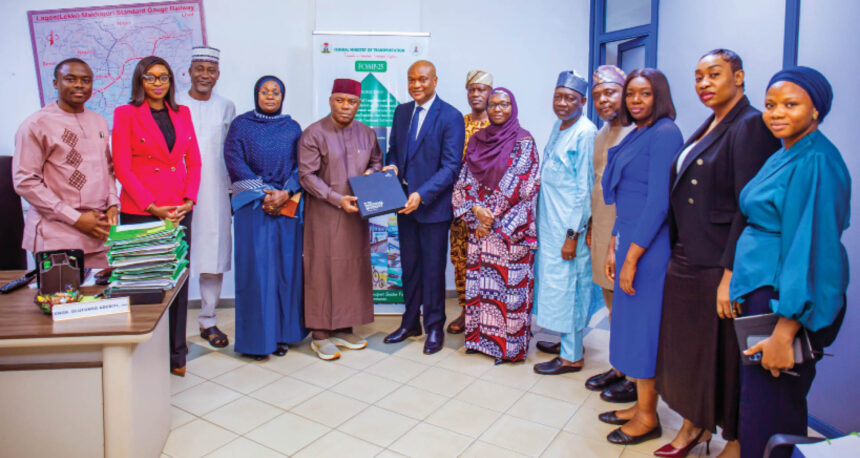
It is against this backdrop that the Nigerian Economic Summit Group (NESG) recently met with officials of the Federal Ministry of Transportation to discuss ways of strengthening collaboration on transport infrastructure development and sector reforms.
The engagement, which involved members of the NESG’s Infrastructure and Allied Services Policy Commission and senior officials of the Ministry of Transportation, focused on challenges affecting the sector as well as opportunities for improving connectivity across the country.
Led by NESG Board Director, Mr. Nnanna Ude, the delegation met with the Permanent Secretary of the Federal Ministry of Transportation, Engr. Funsho Adebiyi, as part of ongoing efforts to encourage dialogue between policymakers and private-sector stakeholders.
While no new project or funding initiative emerged from the discussions, the meeting reflects growing concern about the role transportation plays in Nigeria’s economic performance.
Transport infrastructure serves as one of the foundations of economic activity. Roads, railways, ports, inland waterways and logistics networks determine how efficiently goods move from producers to consumers and how easily people access jobs, services and markets.
When transport systems function efficiently, businesses often benefit from lower operating costs and faster delivery times. When they do not, delays, congestion and inefficiencies can increase expenses across entire supply chains.
Nigeria’s transport sector has long faced challenges associated with infrastructure gaps, uneven connectivity and limited integration between different modes of transportation.
Road networks carry the majority of passenger and freight traffic, while rail, maritime and inland water transport systems continue to evolve at varying rates. In many instances, these transport modes operate independently rather than as components of a fully integrated network.
The result can be higher logistics costs and reduced efficiency in the movement of goods and services.
This is one reason why discussions about infrastructure are increasingly moving beyond the construction of individual projects to broader questions about connectivity.
An integrated transport system seeks to create stronger links between roads, railways, ports and other transport facilities so that people and goods can move more seamlessly between locations and across regions.
For businesses, such integration can improve supply chain performance. For consumers, it can influence travel times and access to services. For the economy, it can affect competitiveness and investment attractiveness.
According to the NESG, the objective of the engagement is to strengthen partnerships that can contribute to the development of “an efficient, integrated, and sustainable transportation system that drives economic growth, enhances mobility, and improves national competitiveness.”
The emphasis on collaboration reflects a wider shift in how infrastructure issues are being approached.
Historically, transport development was often viewed primarily as a government responsibility. Increasingly, however, policymakers, private-sector organisations, development institutions and industry stakeholders are participating in discussions about infrastructure priorities and implementation strategies.
This approach recognises that transport systems influence a broad range of economic actors and that solutions often require input from multiple sectors.
The engagement also comes at a time when infrastructure competitiveness is receiving growing attention globally.
Countries seeking to attract investment and expand trade are increasingly examining how transport efficiency affects economic performance. Reliable transport systems can influence manufacturing activity, export competitiveness, regional integration and overall business confidence.
For Nigeria, where economic activity is spread across a large geographical area, connectivity remains particularly important.
Efficient transportation links can help connect agricultural zones with urban markets, support industrial activity, facilitate trade through ports and strengthen economic interactions between regions.