By Musa Ibrahim
Nigeria’s education reform agenda is moving beyond the redesign of what children should learn to a more fundamental question: what quality of material should be allowed to shape that learning?
The federal government has set a 70 percent minimum benchmark for textbooks to qualify for the national ranking system, following the country’s first national textbook assessment and ranking exercise.
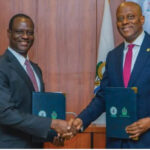
The Minister of Education, Dr. Tunji Alausa, announced the threshold in Abuja while receiving the report and ranked list from the exercise, describing the assessment as part of the government’s broader effort to strengthen quality assurance following the introduction of a revised national curriculum.
The decision creates a new quality filter for instructional materials used across Nigeria’s education system. More importantly, the assessment has exposed significant variations in the standard of textbooks being submitted for use in schools.
Some materials scored as low as 25 percent.
“Some of the books being used in our schools, primary schools, junior secondary schools and senior secondary schools are trash. Some of these books are scoring 25% or lower. Is this the way our children should be educated? If this happened with the government, it will not happen with this government,” Dr. Alausa said.
The finding gives the new benchmark significance beyond a publishing industry requirement. It raises questions about how learning quality has been protected when the instructional materials supporting Nigeria’s revised curriculum vary so widely in standard.
From curriculum reform to quality control
The assessment follows the introduction of the revised national curriculum and is designed to determine whether textbooks actually reflect what the curriculum requires students to learn.
The Nigerian Educational Research and Development Council (NERDC) developed a standardised assessment toolkit benchmarked against international best practices.
Curriculum alignment carries the greatest weight, accounting for 51 percent of the assessment. Other criteria cover language and style, instructional design, technical features, social and cultural compliance, and gender sensitivity.
The weighting is significant because it places the relationship between the curriculum and the textbook at the centre of quality assessment.
A revised curriculum can establish new learning objectives, but those objectives can only reach classrooms effectively if the materials teachers and students rely on accurately translate them into lessons, exercises and explanations.
The 70 percent threshold therefore represents an attempt to make quality assurance more systematic. Rather than leaving textbook selection entirely to individual judgments, the government is establishing a common national framework against which materials can be assessed.
The publishers are not being shut out
The government has also sought to avoid turning the new ranking system into an outright exclusion mechanism for publishers whose books fall below the benchmark.
Dr. Alausa urged publishers to study their assessment results, correct identified weaknesses and resubmit their materials.
“I’m giving you the olive branch, while commending publishers who participated in the exercise despite pressure and blackmail,” he said.
This approach creates a compliance pathway for publishers. A failed assessment does not necessarily end the process. Instead, it identifies deficiencies that publishers can address before returning their materials for consideration.
The effectiveness of that approach, however, will depend on whether the assessment framework is consistently applied and whether publishers respond by improving content rather than simply adjusting materials to meet a numerical threshold.
A three-cycle assessment
The national assessment will be conducted in three cycles covering all levels of the basic and senior secondary school curriculum.
The first cycle covers Primary 1 and 4, JSS 1 and SS 1. The second covers Primary 2 and 5, JSS 2 and SS 2, while the third covers Primary 3 and 6, JSS 3 and SS 3.
This phased approach means the ranking exercise will develop into a broader national quality-assurance mechanism rather than a one-off assessment.
The government also intends to review the curriculum every three years, according to Dr. Alausa, to ensure it remains responsive to emerging educational, technological and societal needs.
That introduces another layer to the reform. Textbooks will have to remain aligned not only with the current curriculum but with a system that is deliberately designed to evolve.
Moving from judgement to evidence
Prof. Salisu Shehu, Executive Secretary of NERDC, said the assessment was conducted within the Council’s statutory mandate to develop, review and promote quality educational materials.
He explained that subject specialists, education experts and NERDC personnel worked with approved criteria and a defined scoring framework.
The process also incorporated peer review and was not dependent on the judgement of a single official.
According to Shehu, the 70 percent score was deliberately adopted as the minimum standard for ranking, meaning submissions below that level would not qualify for the ranked list.
The significance of the process lies in this attempt to move textbook approval from subjective judgement towards documented professional assessment.
For Nigeria’s education reform agenda, that could prove as important as the benchmark itself.
The government has now established a measurable line between textbooks that meet the national standard and those that do not. The harder test will be what happens after the rankings are published.
If publishers use the results to improve content, schools rely on properly assessed materials and future curriculum reviews remain linked to evidence, the exercise could strengthen an important but often overlooked part of education reform.