
By Kngsley Benson
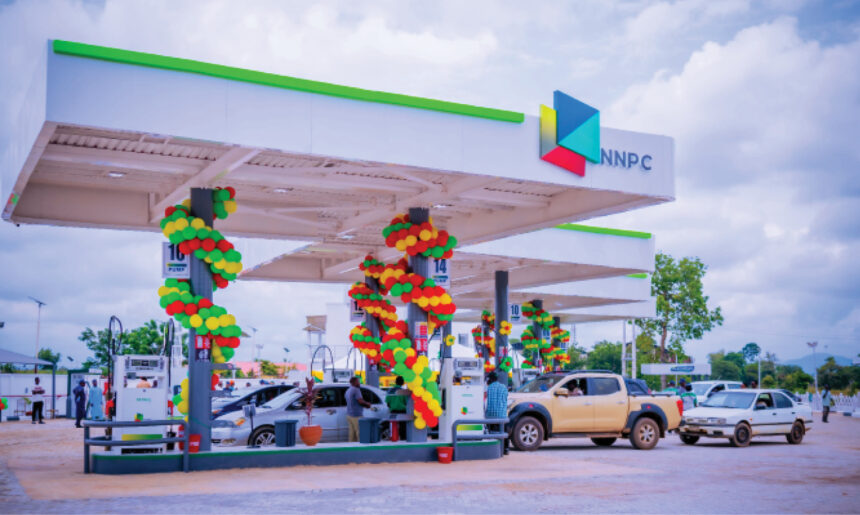
The Nigerian National Petroleum Company Limited (NNPCL) has commissioned its first smart fuel station in Abuja, marking a shift in its retail strategy from conventional petrol stations towards technology-driven energy hubs.
The station, located on Bill Clinton Drive along Airport Road, operates on a 24-hour basis and offers Premium Motor Spirit (PMS) and Automotive Gas Oil (AGO). NNPCL said it plans to commission between 50 and 70 additional smart stations across the country within the next six months.
The company’s Downstream Executive Vice President, Mr. Mumuni Dagazao, disclosed the expansion plan while speaking with journalists on the sidelines of the commissioning.
“We are hoping to roll out a significant number, probably about 50 to 70 of this type of stations within the next six months,” he said.
The new station represents the first phase of what NNPCL describes as a broader transformation of its retail network. Rather than limiting its outlets to the sale of petroleum products, the company intends to combine fuel retailing with a wider range of mobility and consumer services.
“What the whole concept is, we are trying to turn from a filling station to an energy hub,” Mr. Dagazao said.
The station incorporates infrastructure for alternative energy and emerging mobility technologies. Its current operations include petrol and diesel pumps, while Compressed Natural Gas (CNG) and liquefied natural gas (LNG) services are expected to be introduced later.
It also features an electric vehicle charging facility powered by a solar installation mounted on the roof of the station.
Mr. Dagazao said the facility could charge an electric vehicle in about 40 minutes. Although he did not provide the official charging tariff at the commissioning, reports put the cost at about N400 per kilowatt-hour. A fully charged battery costing about N16,000 was also said to provide a driving range of roughly 400 kilometres.
The inclusion of electric vehicle infrastructure signals a broader change in how NNPCL is positioning its downstream business as Nigeria’s transportation and energy markets evolve.
For a country still heavily dependent on petrol and diesel for transportation, the development also places NNPCL’s retail network at the intersection of conventional fuel supply and the gradual emergence of alternative energy sources.
Mr. Dagazao said the smart station concept would not remain limited to a handful of flagship outlets. He indicated that NNPCL wants technological transformation to reach its wider network within a much shorter period than a conventional long-term rollout would suggest.
Rather than setting a 10-year horizon for converting its stations, he said the company should be challenged to deliver the transformation within 10 months.
“If you are hoping good for me, then I was hoping you were going to say 10 months, but to challenge us, right?” Mr. Dagazao said.
“So you need to challenge us. So what we like is our customers challenging us.”
The proposed acceleration would represent a significant change for NNPCL’s retail network if implemented across its stations. It would also require substantial investment in digital systems, alternative energy infrastructure, customer services and the physical redesign of existing outlets.
The company’s vision extends beyond energy vending. In his opening remarks, NNPC Retail Managing Director, Hope Stockman, said the modern consumer expected more than access to fuel.
According to him, customers want quality and quantity at prices they can trust, alongside additional services that make fuel stations more useful destinations.
“The customers want to see more services, added services, like a fast-food restaurant, a convenience shop, maybe a coffee shop, banking,” Stockman said. He stated that customers would also want services such as lubrication and car washing.
That model could turn NNPCL’s retail stations into broader commercial centres, particularly along major transport corridors where motorists already spend considerable time.
The immediate significance of the Abuja station, therefore, extends beyond the introduction of self-service fuel pumps. It offers an early indication of how NNPCL intends to reposition its downstream retail business in a market increasingly shaped by technology, changing mobility patterns and demand for more convenient consumer services.
The challenge will be execution. NNPCL must demonstrate that the smart-station model can be deployed at scale, deliver reliable services and remain commercially viable while introducing CNG, LNG and electric vehicle charging alongside conventional fuels.