Jennete Ugo Anya
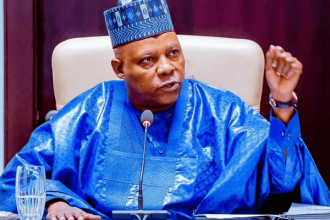
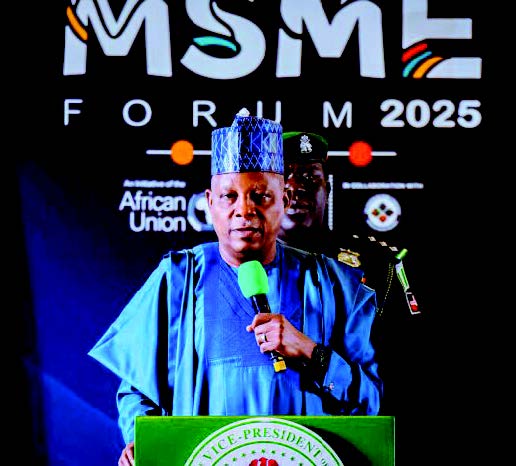
At the 4th Annual African Union Micro, Small, and Medium Enterprises (MSMEs) Forum, Vice President Kashim Shettima delivered a message that cut straight to the heart of Africa’s economic paradox: a continent teeming with energy, innovation, and entrepreneurial grit – yet tethered by informality.
Speaking recently to delegates from across Africa in Abuja, he declared that the future of African prosperity lies not in its skylines or stock exchanges, but in how well it integrates its vast informal sector – which accounts for nearly 90 percent of the continent’s workforce – into the formal intra-African trade framework, especially under the African Continental Free Trade Area (AfCFTA).
“There can be no African prosperity without a strong MSMEs ecosystem. This forum is a continental call to action,” he said.
The Power in the Shadows
For decades, Africa’s informal sector has powered markets, employed millions, and filled the gaps left by underdeveloped formal systems. Yet its players – artisans, traders, micro-manufacturers, and service providers – remain largely invisible to national trade statistics, credit systems, and global supply chains.
Vice President Shettima warned that unless Africa retools its trade architecture to include these hidden engines, the continent risks repeating the “cycle of despair” despite its demographic and economic potential. “Your Excellencies, we owe it to ourselves and to generations unborn to harness the energy of our informal economy and bring it into the light,” he said, as applause rippled through the Bola Ahmed Tinubu International Conference Centre.
MSMEs: Africa’s Real GDP Drivers
Beyond rhetoric, the Vice President offered facts: in Nigeria alone, MSMEs contribute 48 percent of the national GDP and employ over 84 percent of the workforce. They are, he noted, “a mirror to our future.”
That future, however, is constrained. Limited access to finance, poor infrastructure, and inconsistent policy frameworks remain hurdles. But Vice President Shettima struck a hopeful tone, framing the AfCFTA as a once-in-a-generation opportunity to break those barriers and build a new trade ecosystem where small businesses — not just multinationals — thrive.
Digital Innovation, Financing as Game-Changers
Vice President Shettima commended the rise of fintechs and digital tools as catalysts for financial inclusion, especially in reaching entrepreneurs previously excluded from formal credit systems.
“Technology is achieving what politics has long failed to do,” he said. But he cautioned that to sustain momentum, governments must “invest in robust digital infrastructure, bridge literacy gaps, and regulate without stifling innovation.”
These sentiments were echoed by delegates from Small and Medium Enterprises Development Agency of Nigeria (SMEDAN), Nigerian Export-Import (NEXIM) Bank, and the Bank of Industry (BOI), who outlined the steps that their institutions are taking to democratise access to credit and markets.
The European Union (EU), represented by Mr. Massimo De Luca, also pledged continued support – with €1.1 billion already committed to help Africa implement the AfCFTA.
Building Scalable Impact
United Nations Development Programme (UNDP) Resident Representative, Ms. Elsie Attafuah, reminded the forum that African MSMEs are more than survivors. They are innovators and job creators – but they need working ecosystems, policy coherence, and cross-border platforms to scale. “MSMEs cannot thrive on resilience alone,” she said. “They need a system that works with them, not against them.”
Nigeria Signals Leadership Role
With Nigeria hosting the summit and leading conversations around inclusion, digital innovation, and trade access, Vice President Shettima conveyed President Bola Ahmed Tinubu’s vision of a united Africa – one where countries compete globally, not internally. “Our destinies are bound together. We must entrench cross-border cooperation and build for scale,” he stated.
In recognition of his contributions, the AU Sixth Region appointed Mr. Temitola Adekunle-Johnson, Special Adviser to the Nigerian President on Job Creation and MSMEs, as Special Adviser on Job Creation and MSME Development to the African diaspora.
The 4th AU MSME Forum ended with a chorus of commitments, applause, and cautious optimism. For many, the test now is not in declarations but in delivery.