

By Majeed Salaam
Nigeria’s economic relationship with India is taking on a broader character as trade, investment and cooperation increasingly extend beyond the traditional focus on crude oil.
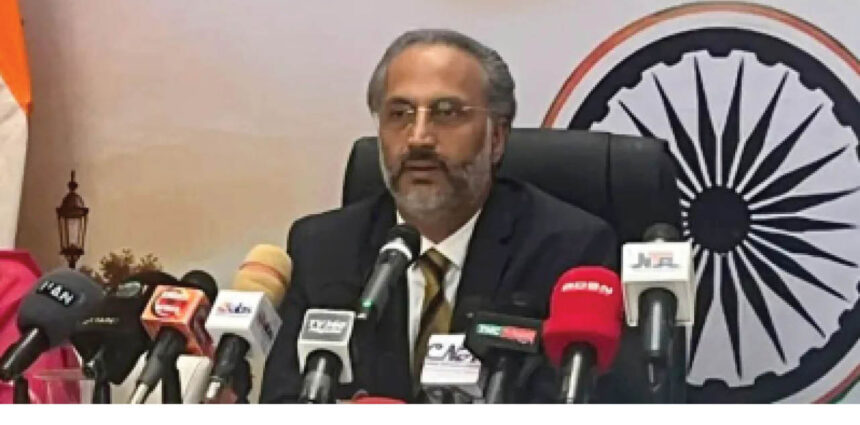
Bilateral trade between both countries reached about US$9 billion in the 2025–26 financial year, up from US$7.13 billion recorded in 2024–25, according to India’s High Commissioner to Nigeria, Ambassador Abhishek Singh.
Singh disclosed the figures during a media engagement with diplomatic correspondents in Abuja, describing the relationship as an expanding strategic partnership covering trade, investment, defence, energy, healthcare, agriculture and technology.
The growth in trade is occurring alongside a widening Indian business presence in Nigeria. More than 200 Indian companies currently operate in the country, according to the High Commissioner, with investments spanning pharmaceuticals, manufacturing, power, construction and healthcare.
These companies have created nearly 100,000 jobs for Nigerians through local production and technology transfer, he said.
The changing structure of the relationship is particularly evident in the energy sector. While crude oil and liquefied natural gas remain important components of bilateral trade, cooperation now extends to petroleum investments, pipeline security, compressed natural gas and liquefied petroleum gas infrastructure.
Energy security is also becoming increasingly connected to wider economic cooperation, as both countries seek opportunities in infrastructure, technology and industrial development.
Security cooperation is another expanding area. Singh said Nigeria and India were strengthening collaboration in intelligence sharing, counter-terrorism, military training and maritime security. A Nigerian naval delegation is expected to visit India for bilateral defence discussions, providing another avenue for institutional cooperation.
The relationship also includes financial and technical support. India has provided US$395 million in concessional credit facilities and technical assistance programmes, with Nigerians receiving training in areas including auditing, education, rural development, electrification and defence.
For Nigeria, such programmes provide access not only to finance but also to technical knowledge and institutional experience.
Healthcare is another significant area of potential cooperation. Singh identified affordable healthcare and pharmaceutical manufacturing as priorities, reflecting India’s established pharmaceutical industry and Nigeria’s need to strengthen domestic healthcare production.
Agriculture also features prominently in the emerging partnership, particularly through agricultural mechanisation and efforts to improve food security. Climate-resilient development has similarly been identified as an area for future cooperation.
The evolution of the relationship reflects a broader attempt by both countries to build partnerships around areas of mutual economic and strategic interest.
Singh attributed the recent momentum to high-level political engagements, including President Bola Ahmed Tinubu’s visit to India in 2023 and Indian Prime Minister Narendra Modi’s state visit to Nigeria in 2024.
Those engagements have provided political momentum for expanding commercial and institutional ties.
The next significant diplomatic opportunity could come in September, when President Tinubu has been invited to the BRICS Leaders’ Summit scheduled to take place in New Delhi on September 12 and 13, 2026.
Nigeria’s participation could provide another platform for discussions on trade, investment, development finance and cooperation among emerging economies.
The growth of Nigeria-India trade to US$9 billion therefore represents more than an increase in commercial value. It reflects a relationship moving towards a wider range of economic activities.
The challenge for Nigeria will be to translate expanding trade and investment into greater domestic production, technology transfer, employment and industrial capacity.
With Indian companies already active across several sectors and cooperation extending into energy, security, healthcare, agriculture and technology, the relationship now has a broader economic foundation on which both countries can build.