
By Jennete Ugo Anya
Nigeria’s challenge in financing economic growth may be less about the availability of capital and more about where that capital goes, the World Bank has said, warning that businesses with the greatest capacity to create jobs are receiving the least access to credit.
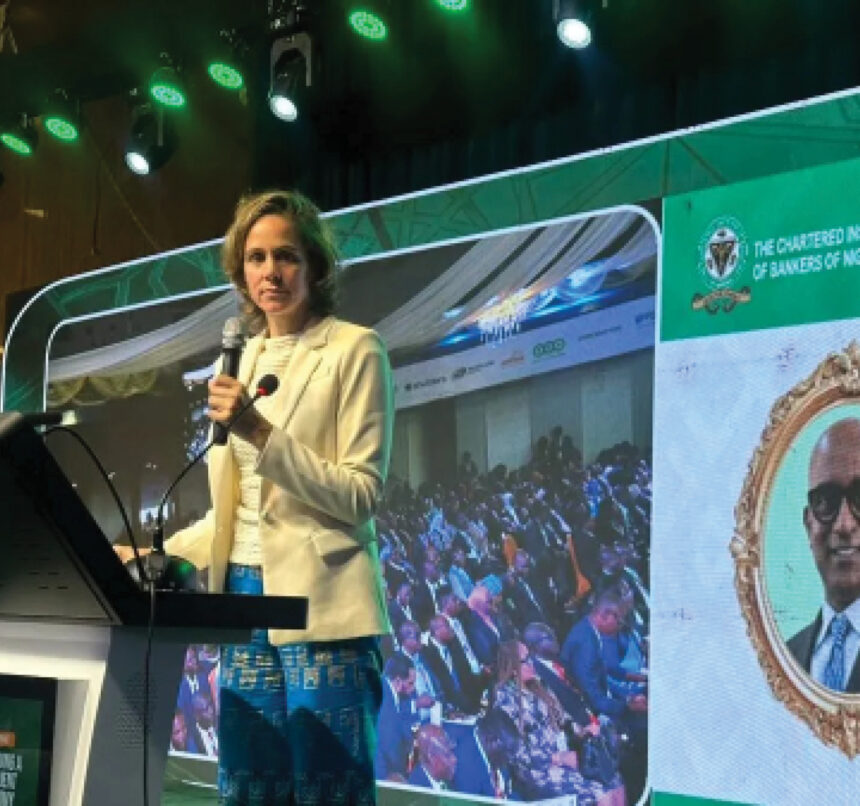
Bertine Kamphuis, Lead Private-Sector Development Specialist at the World Bank, made the observation in her keynote address at the 19th Annual Conference of the Chartered Institute of Bankers of Nigeria (CIBN) in Abuja.
The conference, themed ‘Building a Resilient Economy in an Era of Disruptions: Imperatives for the Banking and Financial Services Industry’, held from September 8 to 9 at the Transcorp Hilton, Abuja.
Kamphuis said domestic credit to Nigeria’s private sector was about 13 percent of GDP, placing the country among economies with comparatively low levels of private-sector financing.
More significantly, she said the distribution of available credit was misaligned with where employment was being generated.
“Credit is thinnest where job intensity is highest,” Kamphuis said.
She explained that micro, small and medium enterprises (MSMEs) receive only about one percent of credit, while agriculture receives about six percent.
“This is where the jobs are. The core observation, to me and to the World Bank, is credit is bypassing the job creators,” she said.
The imbalance carries wider economic consequences as between 3 million and 4 million young Nigerians enter the labour force annually. With government unable to absorb such numbers through public employment, Kamphuis argued that private businesses must carry a greater share of the job creation burden.
For that to happen, she said, the financial system must provide businesses with the capital required to invest, expand operations and employ more people.
Capital is available, but poorly allocated
Kamphuis challenged the assumption that Nigeria’s central financing problem is simply a shortage of capital.
She pointed to the size of existing financial-sector balance sheets and the additional resources available through institutional investors.
Nigeria’s banking system, she said, has about $160 billion in assets, while the recent banking recapitalisation exercise generated approximately $3.4 billion in fresh capital. The pension industry has about $23 billion in assets, while the insurance sector holds approximately $35 billion.
Globally, pension, insurance and sovereign wealth funds control an estimated $110 trillion, representing a substantial pool of capital that could potentially be deployed across emerging markets.
“The balance sheets are strong, and the question is not the availability of capital. The question is the allocation,” she said.
The implication is significant for Nigeria’s economic reform agenda. If capital remains concentrated in relatively safer or more liquid instruments while productive enterprises struggle to secure financing, stronger financial-sector balance sheets may not translate into stronger employment outcomes.
The missing middle remains a financing fault line
MSMEs sit at the centre of the problem.
The World Bank described many of these businesses as part of a “missing middle”. They have moved beyond the scale typically served by microfinance institutions but remain too small, too informal or too risky for conventional bank lending requirements.
“Fewer than one in 20 MSMEs can access bank credit, and about nine in 10 operate informally,” Kamphuis said.
This financing gap matters because the missing middle includes businesses with the potential to grow rapidly and employ significantly more workers if they can overcome constraints around capital, infrastructure and formalisation.
The financing challenge also extends beyond businesses to infrastructure. According to the World Bank, government analysis estimates that Nigeria needs about $100 billion annually to close its infrastructure gap, with energy and transport accounting for almost 60 per cent of the requirement.
Without adequate investment in these areas, businesses face higher operating costs and weaker productivity, limiting their ability to expand and create jobs.
DFIs must use public capital to unlock private money
The World Bank called for greater use of development finance instruments to make commercially viable but initially high-risk investments more attractive to banks and institutional investors.
Kamphuis advocated blended finance, guarantees, credit enhancement and risk-sharing mechanisms to reduce investment risks and unlock pension and insurance funds.
“Every public dollar should be structured to crowd in multiples of commercial and institutional capital,” she said.
She also urged development finance institutions (DFIs) and sovereign wealth funds to assume risks that commercial markets are not yet prepared to price. Their role, she argued, should be to catalyse private investment rather than substitute for it.
The distinction is important. Public finance can have greater economic impact when it is used to make productive investments bankable and bring additional private capital into sectors that would otherwise remain underserved.