By Majeed Salaam
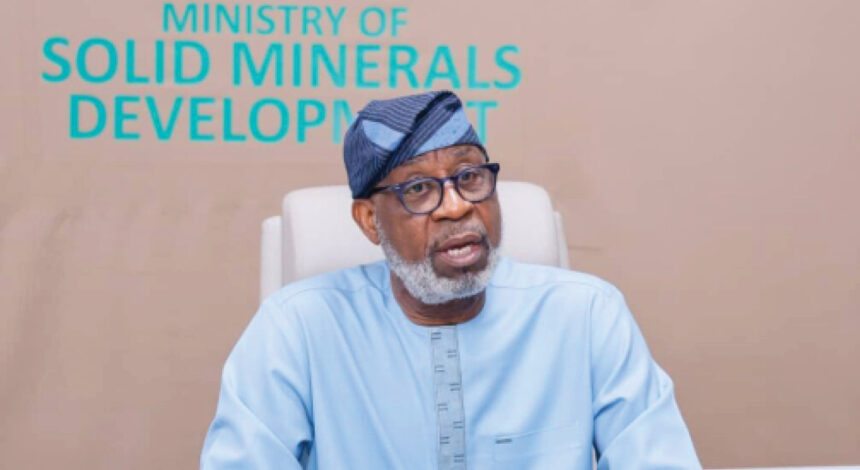
The federal government’s decision to remove the petrol subsidy was a necessary intervention to prevent Nigeria’s economy from sliding further into crisis, Honourable Minister of Solid Minerals Development, Dr. Dele Alake, has said.
Dr. Alake, who recently spoke with journalists in Abuja while discussing the government’s economic reforms, said the subsidy regime had become increasingly unsustainable and disproportionately benefited fuel cartels and wealthier Nigerians rather than the wider population.
President Bola Tinubu removed the subsidy immediately after assuming office in May 2023, making the decision one of the first major economic measures of his administration. The policy triggered a sharp increase in petrol prices and placed additional pressure on households and businesses, but the minister argued that retaining the subsidy would have carried an even greater economic cost.
Dr. Alake said successive administrations had recognised the need for fundamental economic reforms but were reluctant to act because of the political consequences that could follow difficult decisions.
According to him, President Tinubu chose to confront those problems rather than postpone them.
He likened the economic situation inherited by the administration to a person trapped in a hole.
“The solution is to stop digging,” Dr. Alake said, arguing that continuing the subsidy would have amounted to deepening an already difficult situation.
The minister also questioned who actually benefited from the subsidy. He alleged that fuel cartels exploited the price difference created by subsidised petrol by purchasing the product cheaply in Nigeria and moving it across the country’s borders for sale.
He further described the arrangement as inequitable because households with several vehicles could consume considerably more subsidised petrol than Nigerians who owned few or no vehicles.
“The subsidy regime largely benefited fuel cartels and wealthy Nigerians,” he argued.
Dr. Alake acknowledged that removing the subsidy had imposed significant hardship on Nigerians. However, he maintained that the pain was part of the adjustment required to correct economic distortions that had accumulated over many years.
He compared the process to childbirth, where pain precedes the arrival of a new life. In his view, economic reforms can similarly produce difficult short-term consequences before their broader benefits become visible.
The minister rejected the suggestion that Nigerians had waited too long to see the impact of the reforms. He said major economic policies could not produce immediate results because implementation involved several stages, including policy formulation, resource mobilisation, programme execution, monitoring and subsequent adjustments.
“Governments must formulate policies, mobilise resources, implement programmes, monitor their execution and make necessary adjustments before the benefits can be fully realised,” he said.
Dr. Alake said the reforms had already contributed to macroeconomic stability, while their effects were gradually filtering into the wider economy.
The minister consequently urged Nigerians to look beyond the immediate discomfort of reform and assess the structural changes being introduced into the economy.
He also warned against repeatedly resetting economic policies, arguing that consistency was critical if reforms were to deliver lasting results.
“Nigeria needs consistency rather than a reset,” Dr. Alake said, insisting that the reforms were already in place and should be allowed to continue.
His comments place the subsidy debate within the broader question of how Nigeria manages the transition from an expensive intervention-based economic model to one that relies more heavily on fiscal discipline, targeted support and stronger institutions.
Dr. Alake also urged journalists to scrutinise government policies closely but provide sufficient context when reporting economic developments. He said the media had an important role in distinguishing constructive criticism from narratives that, in his view, could encourage attempts to reverse the subsidy reform.
The government’s challenge, therefore, is no longer simply to defend the decision to remove the subsidy. It must demonstrate that the fiscal space created by the policy can translate into stronger public services, productive investment and improved household welfare.
For Nigerians still confronting higher transport and living costs, the ultimate test of the reform will be whether the promised macroeconomic gains eventually become visible in everyday economic life.