
By Anita Dennis
Nigeria’s ambition to transform its mineral wealth into a larger source of industrial growth has gained a new dimension with the signing of a framework agreement with the United States to facilitate American investment in the country’s mining sector, estimated at $700 billion.
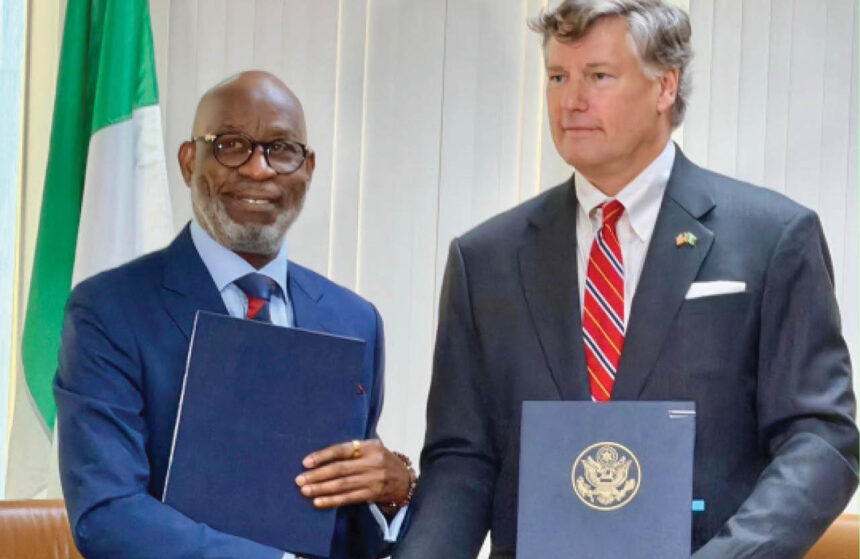
The agreement, signed at Nigeria’s Mission House in New York by Minister of Solid Minerals Development, Dr. Dele Alake, and US Deputy Secretary of State, Christopher Landau, is designed to provide a government-to-government foundation for business-to-business transactions.
At its core is an attempt to connect Nigeria’s mineral resources with investment, technology and infrastructure capable of developing value-added supply chains rather than leaving the country primarily as an exporter of raw materials.
For Alake, the significance of the agreement goes beyond the immediate investment opportunities it could create.
“Some agreements manage the present, and some agreements shape the future. The framework we sign today belongs to the second kind,” Alake said.
He said the pact reflects a shared interest in securing critical mineral supply chains through responsible investment.
“In signing this Framework, Nigeria and the United States affirm a shared conviction: that the supply chains for these critical minerals must be secure, resilient and built on responsible investment,” he added.
The emphasis on critical minerals is significant because the agreement covers areas extending from geological data and exploration to mineral development and processing, infrastructure and technical capacity.
These areas are important to Nigeria’s attempt to move beyond the extraction of mineral resources towards an industrial chain in which processing, skills development and manufacturing generate greater economic value locally.
Alake made that ambition explicit. “We are not here to remain a source of raw material for the values that others create. Our goal is to turn potential into lasting value at home through stronger local processing, new skills, quality jobs, and new opportunities for Nigerian businesses.”
The framework therefore places the mining sector within the wider economic diversification objectives of President Bola Ahmed Tinubu’s Renewed Hope Agenda. Its successful implementation, according to Alake, would support industrial growth while creating opportunities for Nigerian businesses to participate more substantially in the mineral value chain.
But the minister also acknowledged that signing the agreement is only the beginning. The real measure of its significance will be whether it produces commercially viable projects and tangible economic outcomes.
“Now comes the harder and more important work: moving from agreement to implementation. A signature is a promise, results are the proof. In the months ahead, we will identify viable projects, mobilise investments and build the commercial partnerships that deliver measurable benefits to our nations,” the minister stated.
Landau, responding on behalf of the United States, agreed with Nigeria’s position and described the country as an important regional partner.
He noted that Nigeria’s position as Africa’s fastest-growing economy and most populous country made it a regional power deserving of stronger partnership with the United States.
“The signal we are sending is that the United States and Nigeria are partners,” Landau said.
His remarks placed the mining agreement within the broader economic relationship between both countries. He said the pact would contribute to greater prosperity in Nigeria and the United States, describing it as another step towards strengthening economic cooperation.
Landau also pointed to the political commitment behind the relationship, saying that under the leadership of President Donald Trump and President Bola Tinubu, Nigeria and the United States had achieved significant milestones over the past one and a half years.
He expressed the US commitment to building on that momentum and deepening bilateral cooperation.
For Nigeria, the significance of the pact will ultimately depend on what follows the ceremony: exploration that produces viable projects, investment that develops processing capacity, infrastructure that supports mining, and partnerships that create jobs and opportunities for Nigerian businesses.
The framework therefore represents not simply a new investment agreement, but a potential bridge between Nigeria’s mineral endowment and the industrial capacity required to turn geological potential into lasting economic value.