By Musa Ibrahim
Nigeria’s ambition to strengthen its maritime economy is taking shape around a proposed deep seaport and industrial corridor in Ogun State, with the federal government backing agreements that could bring more than $7 billion in investment into the country and create tens of thousands of jobs.
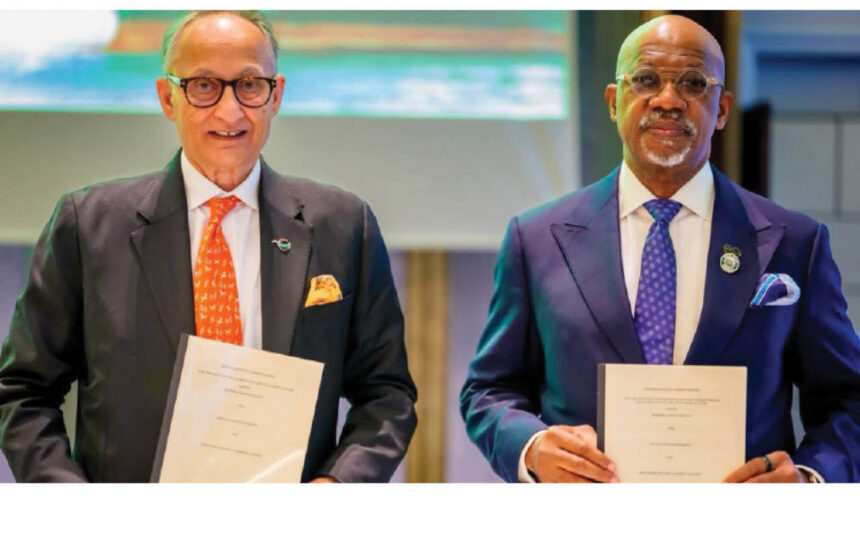
President Bola Ahmed Tinubu has assured investors of regulatory clarity and policy stability following the signing of Memoranda of Understanding (MoU) between Ogun State and DP World for the development of the Ogun State Blue Marine Special Economic Zone and the Gateway Deep Seaport in Ogun Waterside.
The agreements were signed in Paris, France, where Governor Dapo Abiodun led the Ogun State delegation.
For Nigeria, the proposed projects are significant because they combine port infrastructure with an industrial zone designed to support manufacturing, processing, logistics and exports. The concept is intended to create a wider maritime and industrial corridor capable of connecting production to domestic and international markets.
President Tinubu said the federal government would provide the regulatory and institutional support required to move the projects from agreements to implementation. He also said government would hold all parties accountable for the commitments made under the agreements.
The President described the projects as important to attracting foreign investment, expanding productive capacity and strengthening maritime trade.
He said the developments would position Nigeria as a hub for maritime trade, logistics, manufacturing and exports.
At the centre of the proposed corridor is the Gateway Deep Seaport. The facility is planned with a four-kilometre berth and an 18-metre draft, specifications intended to enable it to accommodate larger vessels.
The port is also expected to ease congestion along the Lagos port corridor and reduce pressure on the Apapa and Tin Can Island ports. By providing additional capacity, the project is designed to reduce delays and costs for importers and exporters.
Its potential significance extends beyond Nigeria’s existing port network. The proposed facility is expected to provide a trade gateway capable of supporting commerce under the African Continental Free Trade Area, giving manufacturers and exporters another route into regional and international markets.
The seaport is closely linked to the proposed Ogun State Blue Marine Special Economic Zone, which is planned to cover about 10,000 hectares.
The economic zone is intended to support manufacturing, processing, exports and logistics, creating an industrial base around the port rather than treating the seaport as an isolated infrastructure project.
The agreements envisage an initial investment of more than $7 billion in Nigeria’s economy. When fully developed, the projects are projected to create more than 50,000 direct jobs, in addition to indirect employment and business opportunities.
President Tinubu said the proposed economic zone had already attracted interest from global manufacturing and industrial companies.
The relationship between the two projects is important to the wider investment proposition. An industrial zone requires efficient channels for importing inputs and exporting finished products, while a major port benefits from the economic activity generated around it.
President Tinubu therefore described the Gateway Deep Seaport as critical infrastructure supporting the viability of the proposed economic zone.
The development also reflects the federal government’s broader interest in using infrastructure to diversify the economy. Rather than relying primarily on existing commercial centres, the proposed corridor could create a new concentration of industrial, logistics and maritime activity in Ogun Waterside.
The President said the federal government would work with Ogun State and other subnational governments to remove unnecessary investment bottlenecks.
At the same time, he said the government would respect Nigeria’s laws and regulatory requirements while facilitating investments capable of creating economic value.
Tinubu said that strengthening the maritime economy remained central to the federal government’s economic diversification strategy.
The proposed Gateway Deep Seaport is consequently being positioned not simply as another port, but as part of a broader effort to increase Nigeria’s trade capacity, improve logistics, support industrial production and strengthen the country’s role in regional commerce.
For Ogun State, the projects could also deepen the state’s role as an industrial destination by connecting its manufacturing base more directly to maritime infrastructure and export markets.
For investors, the emphasis from the President was on predictability, regulatory clarity and delivery. Agreements provide the starting point, but the economic impact will depend on whether the commitments are translated into construction, operations, industrial activity and jobs.
President Tinubu called on Ogun State and the investors to sustain the momentum created by the agreements and proceed with implementation.