
By Musa Ibrahim
The federal government has ruled out a return to blanket petrol subsidies, warning that the policy could weaken public finances, pressure the naira and ultimately push fuel prices higher, while announcing fresh measures to cushion the impact of rising energy costs on households and businesses.
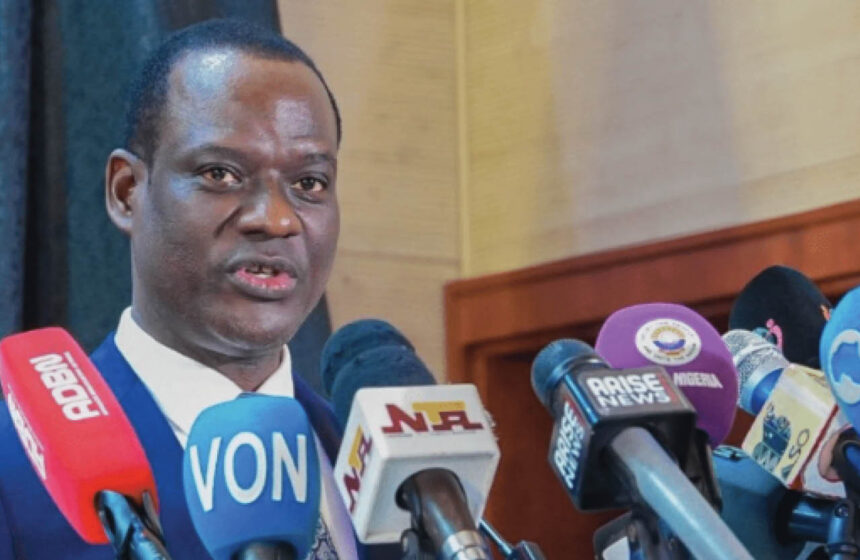
Speaking at a press briefing in Abuja on Thursday, October 8, 2026, the Minister of Finance and Coordinating Minister of the Economy, Prof. Taiwo Oyedele, said the government would prioritise targeted relief and price stability over a broad subsidy regime.
He attributed the increase in petrol prices to global supply disruptions linked to the conflict in the Gulf, which has pushed Brent crude above $100 per barrel and constrained supplies of refined petroleum products. According to Oyedele, petrol that sold for about N830 per litre before the conflict now averages N1,400.
He argued that reinstating subsidies would transfer the cost of higher crude prices, freight and foreign exchange to the government rather than eliminate it.
Nigeria consumes approximately 50 million litres of petrol daily. Prof. Oyedele estimated that restoring the pre-reform price could cost more than N20 trillion annually, while fixing the price at N500 per litre could require over N16 trillion a year, before accounting for increased consumption and smuggling.
He also warned that renewed subsidies could weaken government revenue, increase borrowing costs and undermine recent improvements in foreign exchange stability. He maintained that subsidy removal had released N15.8 trillion to the Federation Account between June 2023 and December 2025, including N10.4 trillion for state and local governments.
The minister said existing measures to moderate fuel costs include tax and duty waivers on petroleum products, local refining, the naira-for-crude arrangement and stronger regulatory oversight. He stated that Nigeria had granted full waivers on petrol taxes and duties worth more than N3.3 trillion for the year to September 30, 2026.
To provide additional relief, the government plans to offer a 30-day petrol margin discount at NNPC Limited stations, prioritising public transport operators. It is also negotiating a N1,350-per-litre ceiling on petrol’s ex-gantry or landing cost, with monthly reviews and published adjustments.
Under the proposed price-modulation arrangement, refiners and importers would initially absorb costs above the ceiling and recover the shortfall when market conditions improve. Prof. Oyedele said the mechanism was intended to smooth price fluctuations rather than impose a permanent price control or subsidy.
Other planned interventions include increased funding for cash transfers to vulnerable households, subsidised credit for small businesses and consumers, faster deployment of compressed natural gas (CNG) vehicles, and measures to eliminate illegal transport and road levies. The government is also considering an excess-profit tax on operators found to be exploiting consumers, with proceeds dedicated to targeted relief.
Prof. Oyedele disclosed plans for a National Strategic Fuel Reserve to protect against future supply disruptions and artificial scarcity. The government also intends to improve traffic and logistics management to reduce fuel consumption and distribution costs.
He acknowledged that existing measures had not fully relieved household pressures but insisted that reversing subsidy removal would create greater economic risks.
The immediate challenge for the government is to ensure that its proposed interventions deliver measurable reductions in transport and living costs without undermining fiscal stability. The minister also said a broader package of fiscal measures aimed at sustainably reducing inflation to single digits would be announced in the coming months.