By Anita Dennis
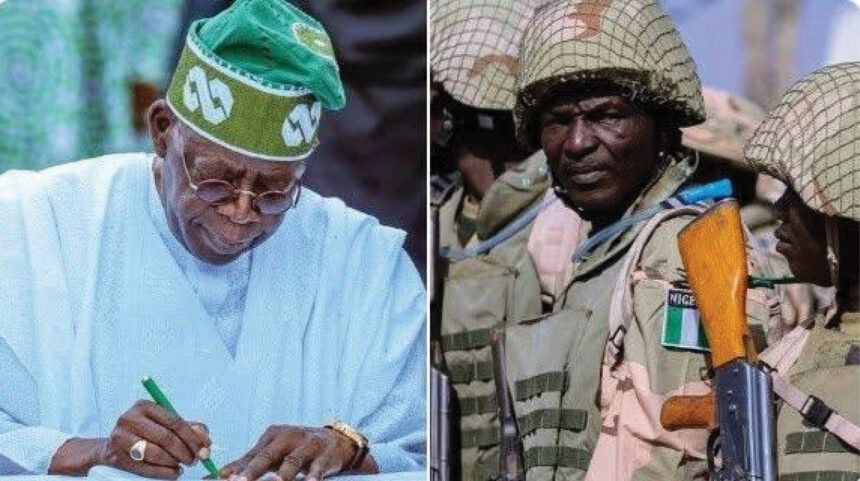
President Bola Ahmed Tinubu has approved salary increases of between 30 and 80 percent for personnel of Nigeria’s armed forces, placing greater emphasis on troop welfare as the country continues to confront banditry, kidnapping and terrorism.
The new pay structure, which takes effect from September 1, will benefit about 250,000 armed forces personnel and raise the annual salary bill from N660 billion to N924 billion.
The increases are graded according to rank. Officers above the rank of colonel, including brigadier-generals, major-generals, lieutenant-generals and generals, will receive a 30 percent increase. Personnel from colonel down to warrant officer will receive a 50 percent increase, while those from private to staff sergeant will receive an 80 percent increase.
The structure places the largest percentage increase at the lower ranks, where the financial effect of the adjustment is likely to be most directly felt by personnel and their families.
The decision also reflects the administration’s broader argument that military effectiveness depends not only on weapons and technology but also on the welfare and morale of those deployed to maintain national security.
Tinubu has repeatedly acknowledged the risks faced by members of the armed forces as they confront security threats in parts of the country.
“The men and women who help to keep us safe in our homes must be supported and appreciated in the course of their duties to our nation,” the President said.
He linked the salary adjustment to a wider commitment to improving military conditions and strengthening operational capacity.
“Our administration will continue to prioritise troop welfare and modernise the armed forces by providing the weapons and technological tools needed to discharge their duties.”
The increase comes at a time when the military remains central to Nigeria’s response to multiple security threats. The President said the relationship between national security and economic development was fundamental to the country’s long-term prospects.
“Our administration believes that no nation can achieve greatness without security. We therefore remain resolute in mobilising all military and law enforcement assets to eliminate security threats and protect the lives and property of all Nigerians.”
Beyond the immediate financial value of the salary increase, the new arrangement is intended to reinforce the government’s recognition of military service and the sacrifices associated with frontline duties.
Tinubu urged personnel to regard the decision as an expression of appreciation for their service.
In a statement signed by Bayo Onanuga, Special Adviser to the President on Information and Strategy, dated August 4, 2026, the President said: “I urge our servicemen to take our gesture as a sign of our deep appreciation of the services they render to our fatherland. Together we shall prevail over the enemies intent on destroying the fabric of our nation.”
The financial commitment involved is substantial. Increasing the annual personnel bill by N264 billion represents a significant additional obligation for the government, but the administration is presenting the expenditure as part of the broader investment required to sustain national security.
The differential increases also suggest an attempt to address pay across the ranks rather than applying a uniform adjustment. With the lowest-ranking personnel receiving the largest percentage increase, the structure gives greater weight to the lower end of the military salary scale.
The effectiveness of the new package will ultimately depend on how it interacts with other aspects of troop welfare, including equipment, housing, healthcare, training and operational support.
For the Tinubu administration, however, the immediate message is clear: improving the conditions of military personnel is being treated as an important component of the wider effort to strengthen Nigeria’s capacity to confront insecurity.
The September implementation will therefore mark not only a substantial change in the armed forces’ salary structure but also a further financial commitment by the federal government to the personnel responsible for defending the country.