REFORM TALKS with Enam Obiosio
For some time now, policymakers, development agencies, and investors celebrate Nigeria’s cassava sector as though it were already an industrial success story. The headlines are always flattering. New factories are announced. Capacity figures are touted. Investment commitments are praised. The narrative is polished, optimistic, and politically convenient. But the truth is far less flattering.
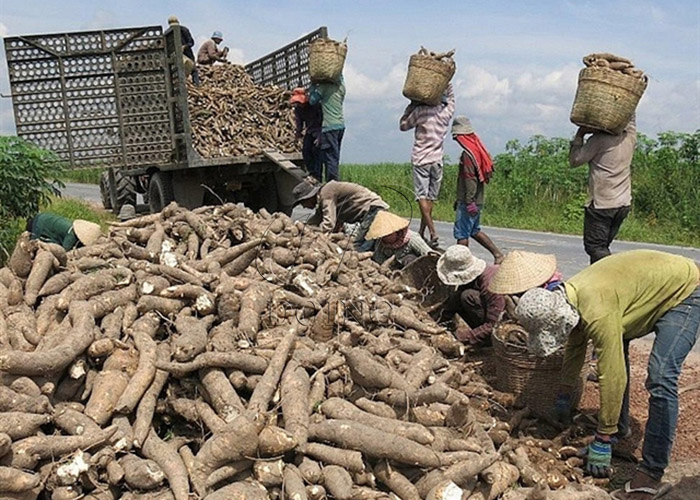
Nigeria’s cassava industrialisation story is not being sabotaged by lack of demand, inadequate technology, or poor investor appetite. It is being strangled by something far more basic and far more embarrassing, a chronic inability to reliably move cassava from farms to factories. Until that reality is confronted honestly, the country’s cassava processing boom will remain more fiction than fact.
I consider it deeply revealing that many cassava processing plants across the country reportedly operate at just 30 to 40 percent of installed capacity. That is not a minor inefficiency. It is systemic dysfunction. A factory built to run at full industrial throughput but operating at barely one-third capacity is not underperforming, it is structurally broken. The economics of industrial processing simply do not tolerate such underutilisation. Fixed costs remain fixed whether the plant runs full or half-empty. Debt obligations do not shrink because cassava failed to arrive. Payrolls do not disappear because logistics collapsed. The result is predictable, margins evaporate, debt service becomes difficult, and once-promising projects descend into financial distress. What is especially troubling is that this problem is not new. It is not hidden. It is not technically mysterious.
Everyone in the sector already knows feedstock reliability is the central determinant of whether a cassava processing investment succeeds or fails. Yet operators and policymakers continue to behave as though processing plants can somehow compensate for weak supply chains. They cannot. Industrial agriculture does not reward optimism unsupported by logistics.
Too much of Nigeria’s agribusiness planning still suffers from a dangerous obsession with infrastructure symbolism over operational reality. We celebrate commissioning factories more than we care about whether those factories can run. We applaud ribbon-cutting ceremonies while ignoring the unglamorous but decisive work of farmer coordination, aggregation, logistics scheduling, and rural procurement systems. In other words, we invest heavily in steel and concrete while underinvesting in the human and operational networks that make the steel and concrete productive. That is not industrial strategy. That is theatre.
What the current cassava crisis demonstrates is that farmer networks are not peripheral support mechanisms. They are core industrial infrastructure. A cassava plant’s true supply chain does not begin at its receiving bay, it begins with the thousands of farmers whose planting cycles, harvest timing, logistics coordination, pricing trust, and contractual discipline determine whether raw material arrives consistently. Without that network functioning effectively, the factory is merely an expensive monument to bad planning.
The most sobering revelation may be that even vertically integrated processors, those that attempt to own farmland and control cultivation directly, still reportedly depend on smallholder farmers for 60 to 70 percent of supply. That should permanently bury the fantasy that processors can simply “farm their way out” of supply insecurity through self-production. They cannot. Not at scale. Not economically. Not sustainably.
The implication is straightforward. Nigeria’s cassava industrial future will rise or fall on whether processors learn to manage smallholder farmer ecosystems professionally. And that is precisely where many are failing.
Managing thousands of dispersed rural producers is operationally hard. It requires discipline, systems, data, field supervision, trust-building, logistics intelligence, and financing mechanisms. It requires treating farmer network management not as a side activity but as a core business function. Too many processors, however, still approach it casually, as though buying cassava should be a simple procurement exercise rather than a complex supply chain operation. It is not.
A mid-sized cassava plant reportedly needs around 3,000 farmers delivering consistently to remain viable. That is not procurement, that is ecosystem management. It demands institutional capability many processors simply do not possess.
This is why the Block Farming Model being highlighted by IDH deserves serious attention. Not because it is magical, but because it reflects an overdue recognition that industrial agriculture requires industrial-grade coordination. Structured farmer blocks, synchronised planting, supervised harvesting, managed input distribution, and aligned delivery schedules are not optional enhancements, they are the mechanics of reliability. They transform farming from fragmented subsistence production into coordinated industrial supply. But even here, realism is necessary.
The Block Farming Model is promising, yet scaling it nationally will be difficult. Nigeria’s land tenure complexities, community politics, infrastructure deficits, and weak rural governance create enormous friction. Securing contiguous land, maintaining discipline across diverse local contexts, and preserving operational integrity at scale will test even the best-designed frameworks. The model may be correct in principle, but execution will remain difficult in practice.
Still, difficulty is not an excuse for inertia. What the sector needs now is less celebration and more operational honesty.
Processors must stop treating side-selling as merely a farmer morality problem and start recognising it as a trust and incentive problem. Farmers sell elsewhere because they often perceive greater value, better payment speed, or lower risk outside structured arrangements. Loyalty cannot be demanded. It must be engineered.
That means faster payments, transparent pricing systems, volume incentives, bundled agronomic support, predictable deductions for input credit, and regular engagement that makes farmers see processors as partners rather than extractive buyers. These are not “soft” interventions. They are commercial necessities. A processor unable to retain farmer loyalty has not secured supply, no matter what its contracts say.
I find it remarkable how often Nigerian agribusiness investors obsess over machinery specifications, land banks, and processing technology while underestimating the strategic importance of farmer relationship architecture. Machines do not create supply certainty. Human systems do. And investors should be paying closer attention.
From an investment standpoint, unreliable feedstock is not a secondary operating issue. It is the primary execution risk. A beautifully modelled cassava plant with credible offtake contracts and modern equipment can still be a terrible investment if feedstock reliability is weak. No sophisticated investor should ignore that. In fact, feedstock reliability should arguably be treated as the single most important diligence criterion in cassava processing deals. If the supply chain is not demonstrably secure, the project is fundamentally impaired regardless of every other attractive feature.
This is where many development narratives around agriculture become misleading. We often frame industrial agriculture as a financing problem, a policy problem, or a technology problem. Those matter, yes. But in cassava processing, the immediate bottleneck is execution discipline at the supply chain level.
Nigeria’s cassava sector does not have a processing problem. It has a reliability problem. And until reliability becomes the industry’s central obsession, the country’s cassava dream will remain exactly that, a dream.