By Jennete Ugo Anya
The Nigerian Export-Import Bank (NEXIM Bank) and the National Association of Small and Medium Enterprises (NASME) have moved to deepen their partnership, with both institutions reaffirming the importance of stronger financial and institutional support for micro, small and medium enterprises (MSMEs) seeking to expand their businesses and compete in domestic and international markets.
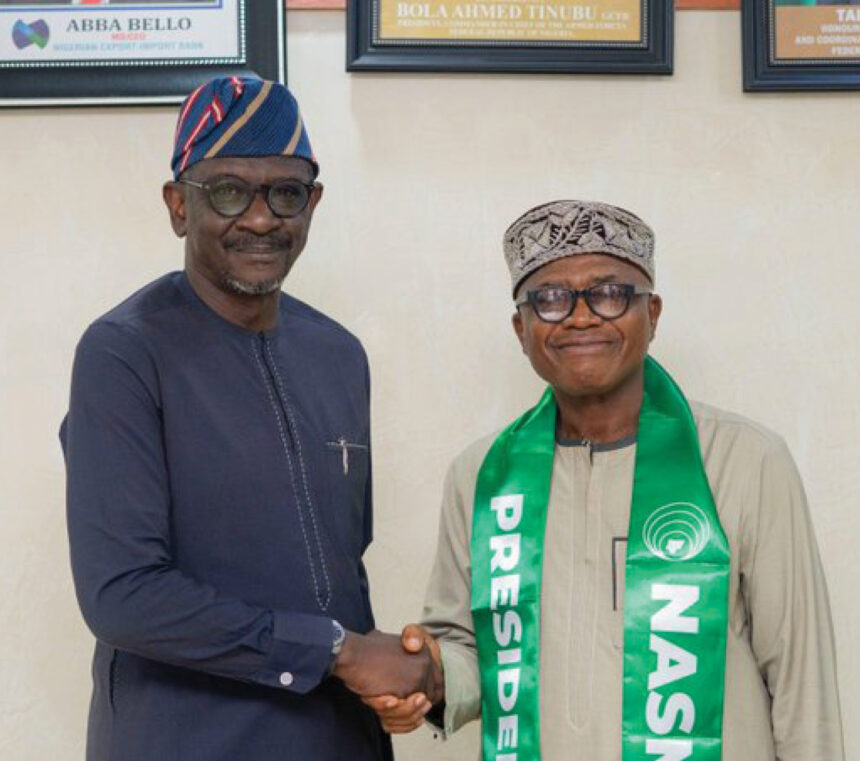
The renewed commitment followed a courtesy visit by the newly elected leadership of NASME to the Managing Director/Chief Executive Officer of NEXIM Bank, Mr. Abba Bello, where the association formally introduced its new President, Sir Theo Norom, alongside members of his leadership team.
NEXIM Bank disclosed the development in a post on its official X handle, noting that the meeting provided an opportunity for both organisations to strengthen their existing relationship and identify areas for mutually beneficial collaboration.
The engagement comes at a time when access to finance, market opportunities, business capacity and export readiness remain critical to the ability of Nigerian MSMEs to scale beyond survival and become more competitive businesses.
For many small and medium-sized enterprises, financing is not only required to establish or sustain operations. It is also necessary for acquiring equipment, expanding production, meeting larger orders, improving product standards and accessing markets beyond Nigeria.
This makes the partnership between NEXIM Bank and NASME significant, particularly given NEXIM Bank’s mandate to support Nigeria’s non-oil export sector and provide financial instruments that can help businesses participate more effectively in international trade.
During the visit, the NASME delegation acknowledged NEXIM Bank’s support for the development and growth of MSMEs. The association specifically highlighted the bank’s contributions in areas including access to finance, export development, capacity building and business expansion.
The acknowledgement underscores the growing importance of financial institutions in helping Nigerian businesses overcome some of the structural barriers that limit their ability to scale.
Beyond access to credit, MSMEs require knowledge, market intelligence, technical capacity and stronger institutional networks to translate financing into sustainable growth. Collaboration between business associations and development-oriented financial institutions can therefore provide a broader support structure for entrepreneurs.
The visit also provided a platform for NASME’s newly elected President, Sir Norom, to outline the priorities of his administration.
According to NEXIM Bank’s account of the engagement, Sir Norom emphasised the need to advance the interests of MSMEs and strengthen partnerships with key financial institutions and other stakeholders.
His vision places collaboration at the centre of efforts to improve the operating environment for small and medium-sized businesses. For NASME, stronger relationships with institutions such as NEXIM Bank could provide opportunities to connect members with financing, export support and other interventions capable of improving business performance.
The emphasis on export development is particularly relevant as Nigeria seeks to expand the contribution of non-oil businesses to economic growth and foreign exchange earnings.
MSMEs account for a significant share of economic activity and employment, but their participation in international markets can be constrained by limited access to finance, inadequate capacity, quality and standards challenges, and difficulties navigating export procedures and markets.
Stronger institutional partnerships could help bridge some of these gaps by linking businesses to financing and the technical support required to prepare them for larger and more competitive markets.
The NEXIM Bank-NASME engagement therefore goes beyond a ceremonial introduction of a new association president. It signals an opportunity to build a more structured relationship between a major business membership organisation and a specialised financial institution focused on supporting trade and export development.
At the conclusion of the visit, both parties reaffirmed their commitment to continued engagement and collaboration in promoting entrepreneurship, strengthening Nigerian businesses and supporting MSMEs to become more competitive both locally and internationally.