By Anita Dennis
Nigeria has taken a significant step toward deepening value addition in its mining sector with the commencement of operations at a high-purity gold refining plant in Lagos and the near commissioning of a $600 million lithium processing facility in Nasarawa State. The developments mark a clear shift in policy focus from exporting raw minerals to in-country processing and beneficiation.
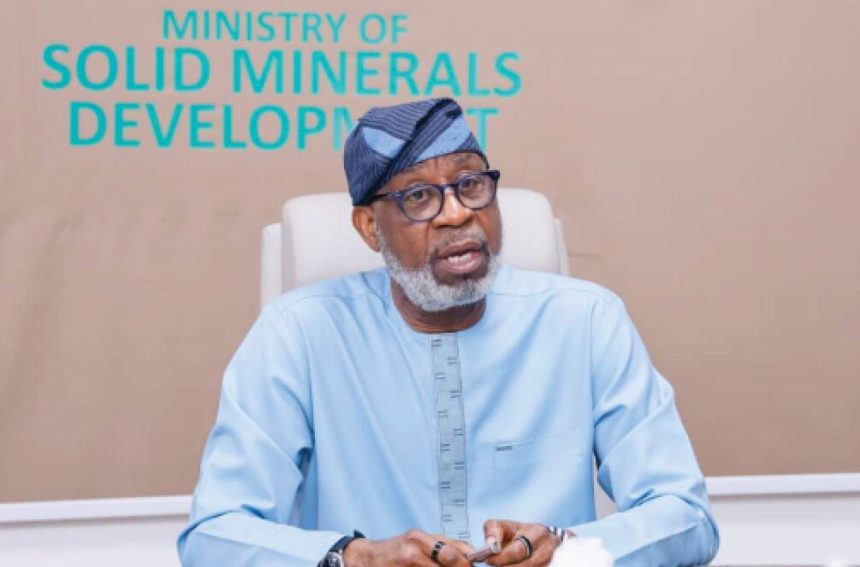
The Honourable Minister of Solid Minerals Development, Dr. Dele Alake, said the new projects underscore the Federal Government’s determination to reposition Nigeria as a leading minerals hub in Africa and a strategic supplier of critical minerals to global markets, particularly those driving the green energy transition.
Beyond the Lagos facility, Alake disclosed that three additional gold refineries are currently at different stages of development across the country, further strengthening Nigeria’s domestic refining capacity and reducing reliance on raw mineral exports.
Policy Shift from Extraction to Processing
Speaking during a meeting with Saudi Arabia’s Minister of Industry and Mineral Resources, Ibrahim Al-Khorayef, the Nigerian minister said the operational gold refinery and the lithium processing plant ready for commissioning represent tangible outcomes of reforms in the solid minerals sector.
The engagement took place ahead of the Future Minerals Forum in Riyadh and focused on translating bilateral discussions into concrete projects. According to Alake, Nigeria’s current reform drive is designed to ensure that minerals extracted locally generate higher economic value, create jobs, and support industrial development within the country.
Lithium, in particular, has become a strategic priority as global demand accelerates for battery storage, electric vehicles, and renewable energy systems.
Lithium and the Green Energy Supply Chain
The $600 million lithium processing plant in Nasarawa State is expected to play a pivotal role in positioning Nigeria within the global clean-energy supply chain. With lithium classified as a critical mineral for energy transition technologies, local processing is seen as essential for capturing greater economic benefits from Nigeria’s mineral endowment.
Alake noted that Nigeria’s vast landmass and abundance of critical minerals and rare earth elements offer strong foundations for long-term partnerships, provided such collaborations are structured around fairness, equity, and mutual benefit.
Deepening Nigeria–Saudi Cooperation
During the meeting, the minister said Nigeria is keen to expand cooperation with Saudi Arabia in capacity building, professional training, technology transfer, and mineral exploration. He revealed that a joint working group comprising officials from Nigeria and the Saudi Chamber of Commerce has been active over the past year and is expected to submit its report before the conclusion of the Future Minerals Forum.
Priority areas identified for collaboration include mineral traceability, Environmental, Social and Governance standards, and mine-pit remediation. According to Alake, improved traceability systems would enhance investor confidence, particularly if supported by clear timelines and robust monitoring and evaluation frameworks.
Saudi Arabia Signals Support
In his response, Al-Khorayef reaffirmed Nigeria’s importance as a long-standing partner of Saudi Arabia and agreed on the need for practical, results-oriented agreements in the solid minerals sector. He proposed that the joint working group prepare a draft memorandum of understanding for possible signing on the sidelines of the conference.
The Saudi minister also encouraged Nigeria to use the Future Minerals Forum as a platform to showcase mining investment opportunities to Saudi investors. He urged African countries to adopt advanced mining technologies, noting that Nigeria could benefit from Saudi Arabia’s experience in modern mining practices and regulatory frameworks.
Reforms Gather Momentum
Nigeria has intensified reforms in the solid minerals sector in recent years, targeting illegal mining, strengthening regulation, and improving the investment climate. Gold, lithium, and other critical minerals have emerged as central pillars of the country’s economic diversification strategy, as well as its ambition to integrate into global clean-energy value chains.
With gold refining now underway in Lagos and lithium processing capacity coming on stream in Nasarawa, the government is signalling that its minerals policy is moving from intent to execution. The challenge ahead will be to sustain regulatory clarity, attract long-term capital, and ensure that value addition translates into broad-based economic gains.